Modular software to help museums manage and create immersive exhibitions.
This includes exhibition management software for museums to manage their own exhibitions and their content. For the visitor it means having a clean, easy to use check-in and check-out experience with the possibility to receive a custom summary of their tour by email.
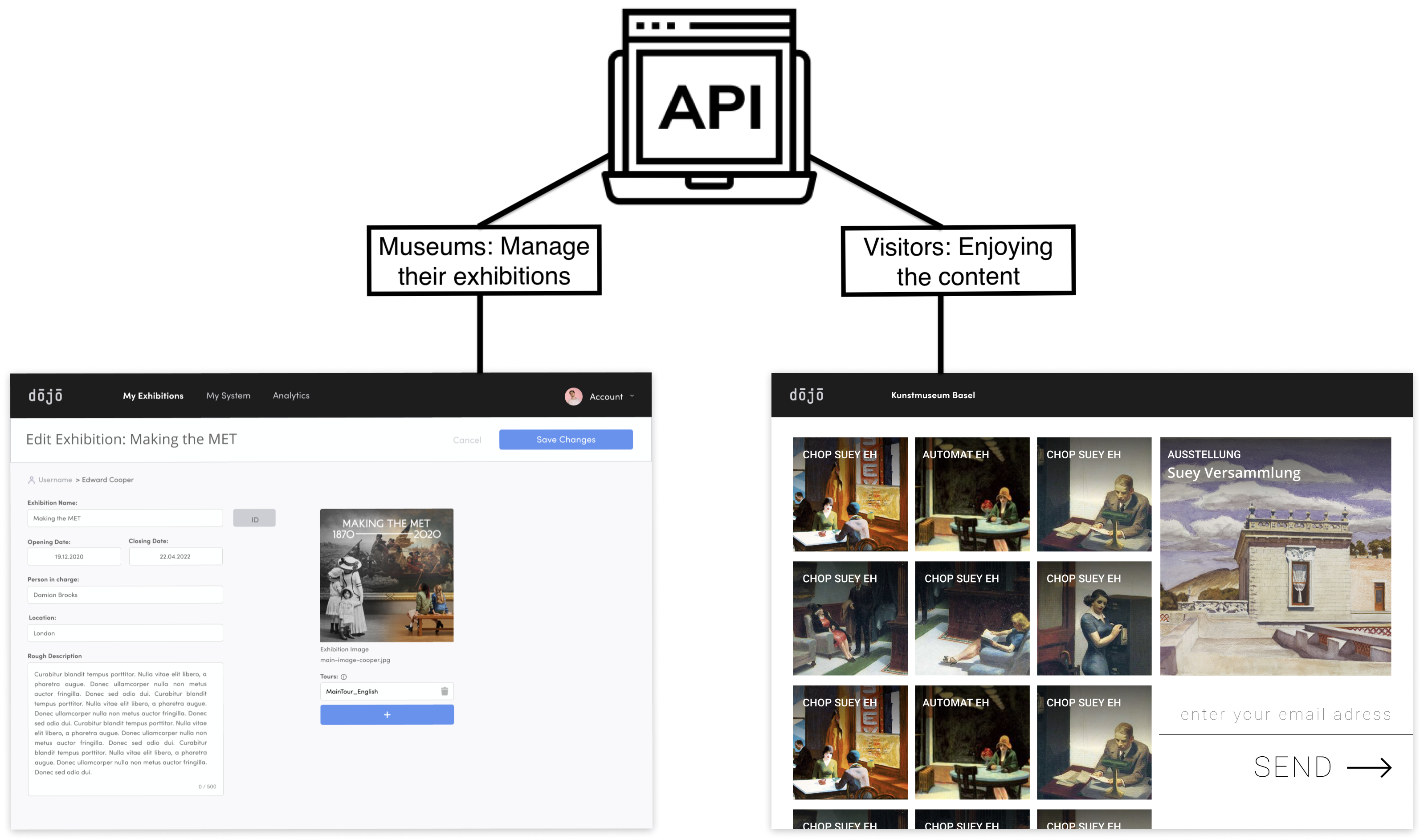
By building an API driven system we can support multiple frontend applications and provide them with consistent data. Thus enabling exhibitors to create content that can be enjoyed by every visitor. A lot of effort went into creating the right UI/UX to enhance the use of the software
API stands for Application Programming Interface. It helps two or more applications to talk to each other and exchange data.
UI/UX will refer to User Interface and User Experience, which describes the look and feel of the software.
Web Application
Locally or Cloud hosted
Desktop
Any modern browser
Mobile and Tablets
Any modern browser
Java Script
Programming Language
GraphQL Apollo
API Scheme
React
Frontend Library
Jest
Testing
Material UI
Styling Library
Kotlin
Programming Language
GraphQL Apollo
API Scheme
Spring Boot, Core
DB Access
JUnit 5
Testing
Mockito
Testing
GitLab
Repository
Git
Version Control
Gradle
Build Tool
Yarn
Package Manager
ESLint
Code Style
Docker
Deployment
PostgreSQL
Database
Figma
UI / UX Design
Our goal was to help the Dojo team create management software for their new product: The Dojo stick.
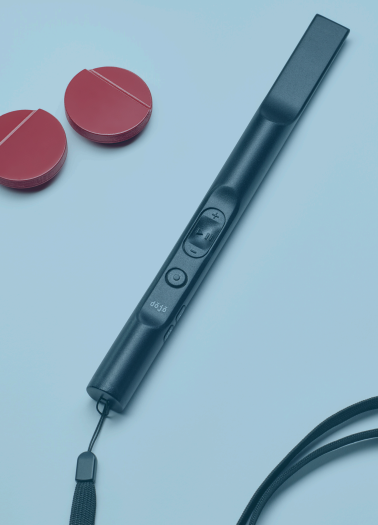
Picture of a Dojo stick
This innovative IoT device functions as an audio guide that emits sound by bone conduction. However, the product is still under development and it needs software to manage and prepare exhibitons to later upload them to the device itself.
That's where the FHNW student team helped the Dojo team to develop the user interface and experience, as well as parts of the software. The software was to consist of 4 parts:
We ended up building the Dojo API, the Exhibiton Management, and designing the UI/UX of the Kiosk Terminal using Figma. This restriction was due to the Covid-19 situation shutting down IP3.
The Dojo API serves as the single point of truth for all Dojo related data. All other software components are to access this API to display and manipulate data.
The Exhibition Management is the software used by museums and exhibitors to create and manage their exhibitions. This allows the museum the ability to set up audio tracks and other bookmarkable content for each unique tour.
The Kiosk Terminal is the software used by museum visitors. A visitor will check-in using a touch device. Then they will select a tour for which they will be guided by the audio guide.
When leaving the exhibtion they will check-out and receive a summary of all content they bookmarked on the dojo stick during their stay.
We started the project without source material to begin with. Most artefacts were created with the client in separate focus meetings. The UI/UX team and the developer team worked in parallel to gain the most momentum. The dev team started by setting up the repositories, initializing the tech stack and developing the first iteration of the database scheme. The UI/UX team developed the Exhibition Management with the client as Figma prototype, so that the developers were able to start implementing it when IP4 began. While the Exhibition Management was being constructed the UI/UX team sketched the Kiosk Terminal together with the customer.
Because of the dojo stick still being under construction and the startup being founded during the project time the scope and needs for the software were prone to change. Our modular approach and splitting the concerns into different small applications enabled us to react to change rapidly. No matter how the business is going to change, the API will be able to change with it and provide it's functionality to each application connected. By keeping the user interfaces lean and bound to one purpose they can easily be adapted to match any change that is about to happen. Since the UI/UX team worked closely with the customer we are certain that we built the right application and prepared them to showcase their vision to potential exhibitors and museums.
The API was designed to meet all endpoints needed in the Exhibition Managment. This includes endpoints for CRUD operations, find and findAll methods.
Create, Read, Update and Delete
Our client asked us to put more time and effort into a clickable Figma prototype for the Exhibition Management to showcase new features and UI/UX elements they came up with in the later stages of IP4.
In order to showcase the vision and check -in and -out experience, we developed a clickable prototype with our customer to showcase the whole functionality to a potential exhibitor.
The team consisted continously of the same 8 students. All of which study part time.
The team fullfilled roles within an agile project management scope.

Kevin Zellweger
cand. BSc Informatik

Damian Zehnder
cand. BSc Informatik

Peter Schmucki
cand. BSc Informatik

Fernando Rauch
cand. BSc Informatik - iCompetence

Linus Vettiger
cand. BSc Informatik

Joshua Villing
cand. BSc Informatik

Eduard Jung
cand. BSc Informatik

Fabian Henzmann
cand. BSc Informatik - iCompetence

Valerie Safai
MAEd, English Lecturer

