
Extended Reality for Training Paramedics
A trainee in a headset can look at a casualty and decide what is wrong, but cannot feel a chest. This bachelor thesis puts the physical half of the work back into the simulation, using a torso built from a padded jacket and a head form and a headset controller that measures every chest compression.
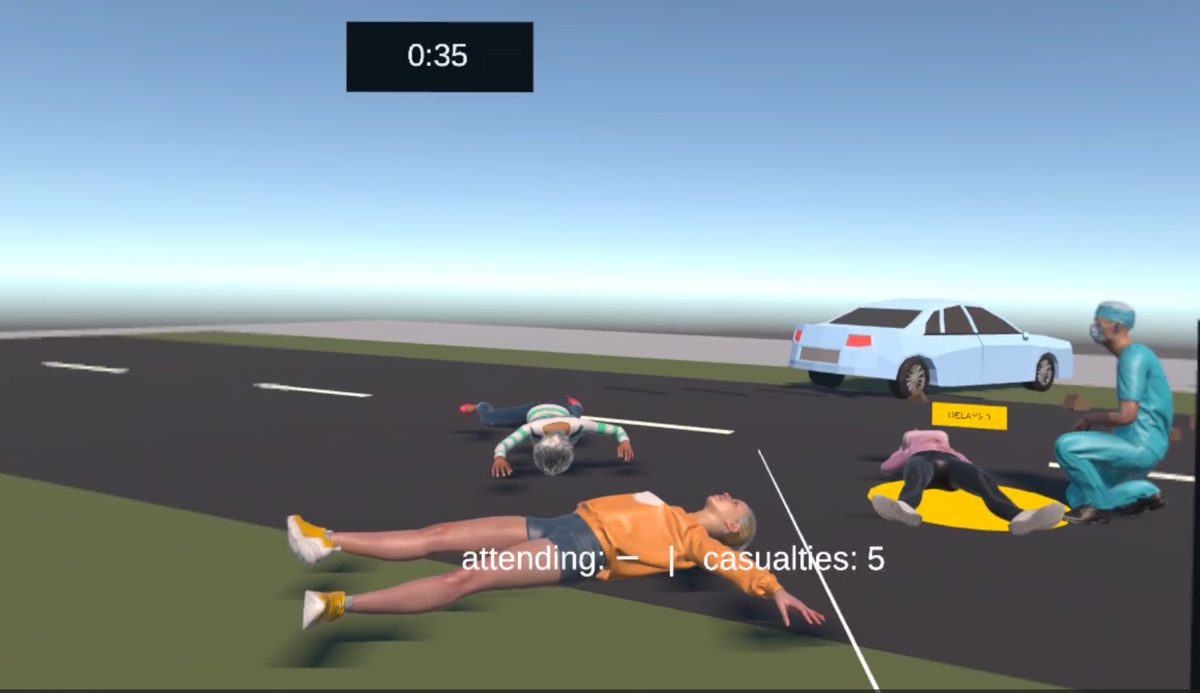
Triage phase of the implemented road traffic collision, seen through the headset
Initial situation
Paramedics have to rehearse cases that cannot be practised on patients. The established way of doing so is to have a person play one: an actor or a colleague presents the casualty, a room is arranged to stand in for the place where the emergency happened, and an instructor supplies whatever the presentation cannot. The method works, and it is expensive in the things training providers have least of. Every session needs the actor, the instructor, the room and a slot in which all three are free, and how convincing the case is depends on how well the person playing it acts.
Extended reality removes most of those dependencies. A scenario that exists as software can be repeated without booking anything, can be presented identically to every trainee, and can be set in a place no institution could build. What it does not remove is the part of the work that happens through the hands. A trainee wearing a headset can look at a casualty, decide what is wrong and say what they would do. They cannot feel a chest, and any attempt to push on one meets empty air.
Problem statement / Project goal
A systematic review of 34 studies of extended reality in emergency medicine names haptic fidelity, what the hands feel, as the outstanding deficit of the medium. The same asymmetry turns up independently in police, fire and military training: these systems are strong on decision-making and weak on the physical execution of the task. The gap is therefore a general one, and it is the gap this project addresses.
The goal was a working prototype in which a trainee performs a prehospital case in a headset, and in which the parts of that case that are physical are physical. Three criteria were fixed at the start. The clinical content had to come from published prehospital practice and from a paramedic collaborator. Everything the approach depends on had to be publishable, so that another institution can rebuild it without taking the result on trust. And the system had to measure what a trainee did, at a resolution that allows the physical element to be judged against something other than opinion.
The scenario
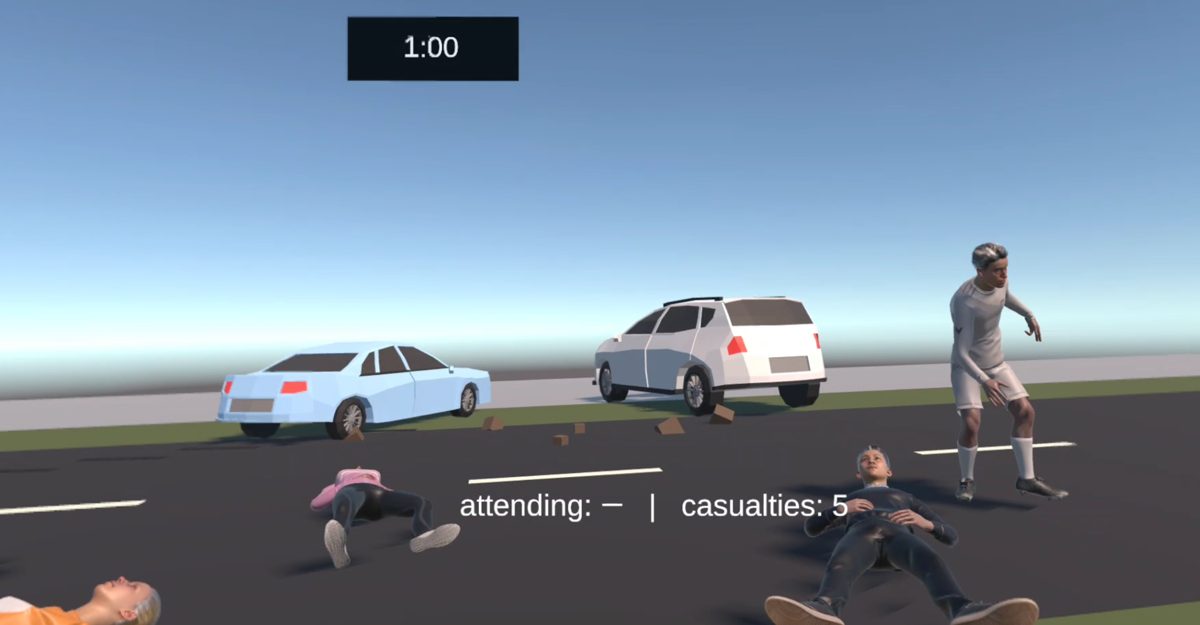
A road traffic collision with five casualties, triaged under a time limit. Each casualty carries its own injuries, vital signs and correct category, and the triage scheme itself can be swapped while the application is running.
The physical proxy
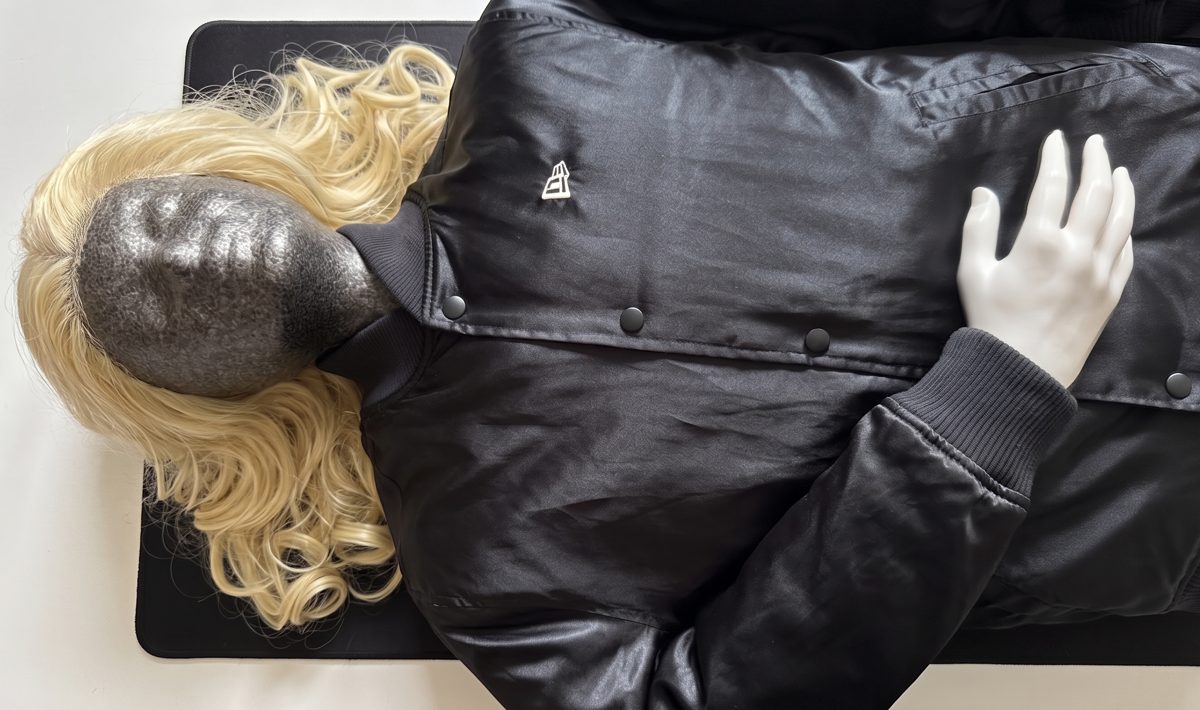
A padded jacket, a polystyrene head form, a wig and a display mannequin hand on a foam mat. The head and the hand exist so that the body reads at a glance as a body; the jacket is the surface the hands land on.
Compression with feedback
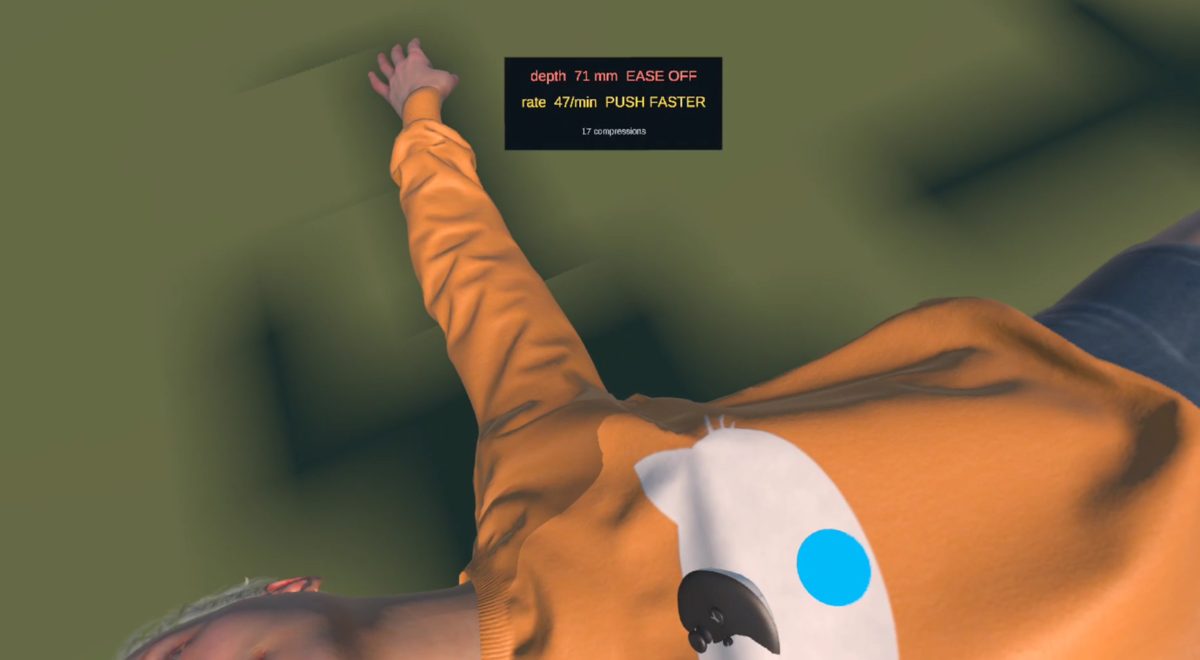
The virtual casualty is laid onto the physical proxy, and compression depth, rate and recoil are read from the proxy itself. Depth and rate are shown live and scored against the adult basic life support targets.
Solution developed and its benefits
Fifteen approaches to supplying the missing physical dimension were surveyed and compared. Gloves and exoskeletons reproduce the feel of contact convincingly, resist movement poorly, cost between hundreds and tens of thousands of francs, and occupy the hands that the task itself needs. The approach selected is the cheapest one the evidence supports: passive haptics, a physical proxy registered to the virtual casualty, on a finding first demonstrated in a doctoral study in 2001, that an object need only resemble what it stands for at the places where the user actually touches it.
The prototype runs on a Meta Quest 3. A road traffic collision with five casualties is triaged under a time limit; one casualty then arrests, and chest compressions are performed on the proxy, a soft torso assembled from ordinary materials. Registration is a single action: the trainee lays a tracked controller on the chest of the proxy and squeezes that controller's trigger, which fixes the compression point, the direction the body is lying in and the resting height of the chest surface in one press. The controller then stays where it is and works as the depth sensor, which leaves both hands free for the compressions. A commercial CPR feedback device takes that same form, so the arrangement is the established one.
What the system offers a training provider:
- a scenario that can be run anywhere there is a room and a headset, with no actor, no instructor and no booking
- a compression task performed on something solid, so depth and recoil are measured from the proxy itself; an observer standing beside a trainee can only estimate them
- live guidance on depth and rate during the compressions, and a scored session summary afterwards
- a full record of what the trainee did: which casualty was attended when, which category was assigned, and how each compression compared with the target
- clinical content authored as data, so casualties, environments and whole scenarios can be added without touching code or opening a development environment
- a triage scheme that can be exchanged at runtime, which keeps the same scenario usable under different doctrines
- a published parts list: every component except the head form is ordinary household or shop-display material, so an institution that already owns a padded jacket and a mat spends a few francs, and one buying everything new at Swiss retail spends about a hundred
The boundaries of the result are stated as plainly as the result itself. The stiffness of the proxy is neither designed nor measured, so the system does not teach how much force a real sternum demands. It cannot see hand placement or arm position, and the treatment phase covers chest compression alone. A manikin remains the better instrument for the things a manikin is for; this prototype is a complement to it and not a replacement, and its value is that it makes repetition cheap.
Both halves of the system are reproducible on purpose. The parts list, the registration method, the software architecture and the data format the clinical content is authored in are all documented in the thesis, and the source code is held at the Institute for Interactive Technologies. A result that works only in one laboratory with one apparatus is of little use to a training provider.
Key terms
- Extended Realityheadset-based simulation covering virtual, augmented and mixed reality
- Passive hapticsa physical object standing in for a virtual one, so that touch has something to meet
- Paramedic trainingprehospital emergency care, rehearsed before it is needed
- Mass casualty triagesorting several casualties by urgency under time pressure
- Chest compression feedbackdepth, rate and recoil measured against the basic life support targets
- Meta Quest 3the standalone headset the prototype was built for
- Unitythe engine the application is implemented in
- Simulation-based educationthe training practice this work extends
Client
Institute for Interactive Technologies, FHNW
Bahnhofstrasse 6
5210 Windisch
www.fhnw.ch/iit
Team
Michelle Wächter
Advisors
Prof. Dr. Arzu Çöltekin
Elif Gürcinar
Luca Fluri