
Exploring Acceptability and Integration Strategies for Care Robots in Senior Homes
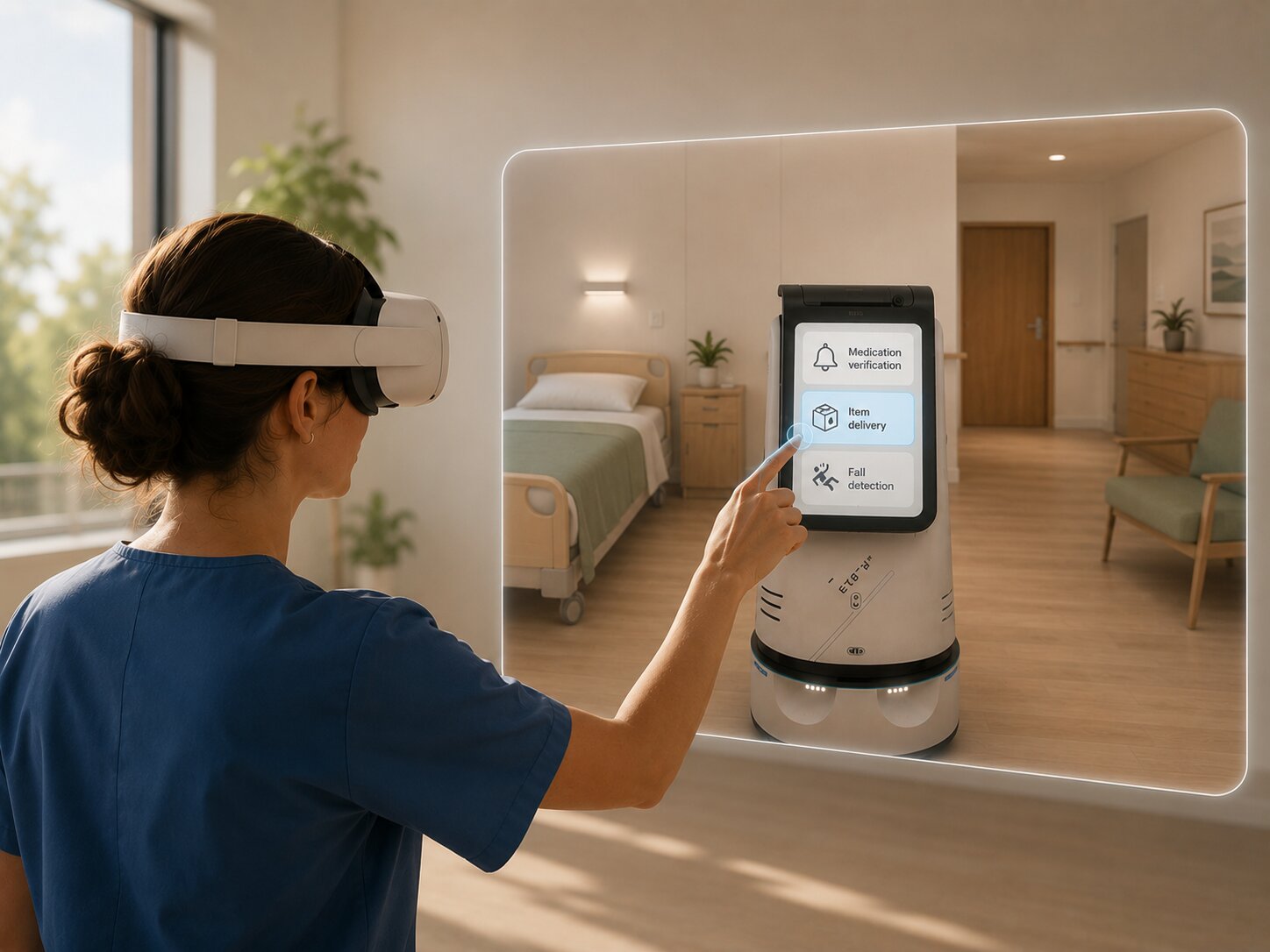
A VR-based framework for introducing care robots into senior homes. Three interactive scenarios test how caregivers accept and trust robotic assistance, from simple support tasks to safety-critical monitoring.
Initial situation
As the population ages, demand for residential care services is steadily increasing. Caregivers face persistent challenges such as physically demanding tasks, rising workloads, and limited time for relational aspects of care. While robots could support with routine activities, technical feasibility alone is not enough. Acceptance depends on trust, transparency, and integration that respects caregivers' needs and concerns.
Problem statement and Project goal
This project investigated how care robots can be meaningfully introduced into senior homes, focusing on caregiver acceptance, trust, and human control. The goal was to develop a gradual integration framework in which robots begin with clearly defined, low-risk support and progressively take on more autonomous and safety-critical tasks. The framework was evaluated through three interactive VR scenarios with caregivers.
Phase 1: Familiarisation

Medication Reminder and Verification
The robot supports the caregiver with a clearly defined task while remaining under close supervision.
It reminds the caregiver about upcoming medication and verifies the selected medication through barcode scanning.
The caregiver remains fully responsible for preparing and administering the medication, while the robot acts only as a reminder and verification tool.
This phase allows caregivers to become familiar with the robot without transferring clinical responsibility.
Phase 2: Workload Reduction

Delivery of Requested Items
After initial familiarisation, the robot takes on a more autonomous logistical task. The caregiver requests an item, such as water, through the robot’s interface.
The robot then navigates independently to collect and deliver it.
Although the robot operates away from the caregiver, the task remains low-risk and allows caregivers to stay with the patient while reducing their workload.
Phase 3: Safety-Critical Support

Fall Detection and Alerting
In the final phase, the robot supports a more safety-critical task. It monitors a shared space for unusual movements or falls and alerts the caregiver through sound and a visual notification when an incident is detected.
The caregiver assesses the situation and decides on the appropriate intervention. This phase requires greater reliability and transparency, while ensuring that responsibility and decision-making remain with the caregiver.
Solution developed and its benefits
Three interactive VR scenarios were designed and implemented to evaluate a phased integration framework for care robots. The framework progresses from low-risk support tasks to more safety-critical applications while maintaining caregiver control at every stage.
Key benefits
- Supports caregivers without replacing their clinical judgment
- Gradually builds trust through familiarization, workload reduction, and safety-critical support
- Provides clear feedback and requires caregiver confirmation at every step
- Developed based on real caregiver interviews and evaluated with healthcare professionals
- VR simulation enables realistic testing without the cost of a physical robot prototype
The scenarios were evaluated with four professionals from Spitex Unicare. Results showed that caregivers prefer a gradual introduction starting with simple, low-risk tasks before progressing to more autonomous functions. Trust was highest for clearly defined, non-clinical tasks and was influenced by transparency, familiarity, and the perceived consequences of errors. Participants generally saw robots as support tools rather than replacements.
Technologies
The VR prototype was developed in Unity (C#) for Meta Quest Pro. It uses the Meta XR All-in-One SDK and the XR Interaction Toolkit for VR integration, interaction handling, and UI.
Key terms
- Care robotsRobotic systems designed to support caregivers with routine, logistical, and monitoring tasks in healthcare environments.
- Gradual integrationA phased approach to introducing robots, starting with low-risk collaborative tasks and progressively increasing autonomy as trust develops.
- Caregiver acceptanceThe willingness of healthcare professionals to adopt and trust robotic assistance, influenced by factors such as reliability, transparency, and control.
- Technology Acceptance Model (TAM)A framework for understanding technology adoption based on perceived usefulness and perceived ease of use.
- VR simulationA Virtual Reality prototype used to test human-robot interaction concepts in a controlled, safe environment before physical implementation.
- Human-Robot Collaboration (HRC)Interaction between caregivers and robots where the robot acts as an assistant and the caregiver retains responsibility for all clinical decisions.
Customer

Spitex Unicare AG
Thileepan Koneswaran
Hintermättlistrasse 3
5506 Mägenwil
Spitex Unicare AG
Team
Selina Lanz
Michelle Rickenmann
Advisor
Prof. Dr. Kevin Gonyop Kim