
AI-Based Retinal Vessel Segmentation under Sparse Annotation Constraint
Generation of denser pseudo-labels from sparse annotations in optical coherence tomography (OCT) to improve blood vessel detection, and subsequent evaluation of pseudolabels in applied scenario.
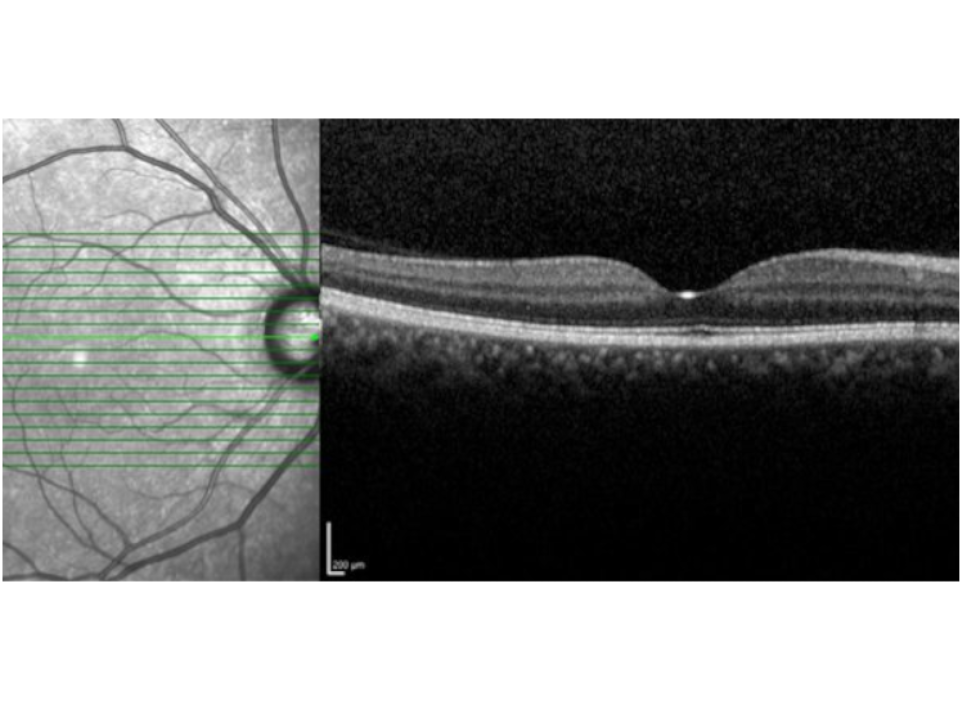
Example OCT scan, adapted from Gene Vision (https://gene.vision/retina/), n.d. Left: en-face view of the fovea
with the marked slice indicated; right: the corresponding B-scan cross-section.
Initial situation
Retinal blood vessel segmentation in optical coherence tomography (OCT) is an important step in the analysis of vascular pathology, and automating it is therefore of considerable practical value. Such automation depends on annotated data, which is expensive and difficult to obtain for this modality, as low contrast and the sheer number of frames make exhaustive labelling infeasible.
Problem statement / Project goal
Annotation of vessels in OCT B-scans is laborious and requires specialised clinical expertise. The vessels in cross-sectional B-scans appear only as signal-poor lumina with posterior shadowing, and their visibility fluctuates across frames with pulsatile flow. Producing consistent annotations across the hundreds of frames of an OCT video is therefore infeasible in practice, and as such dense supervision of this kind is known to be expensive and difficult to obtain. This motivates the use of sparse, weakly-supervised annotation, in which only a small number of vessel centrelines are labeled.
Study Design
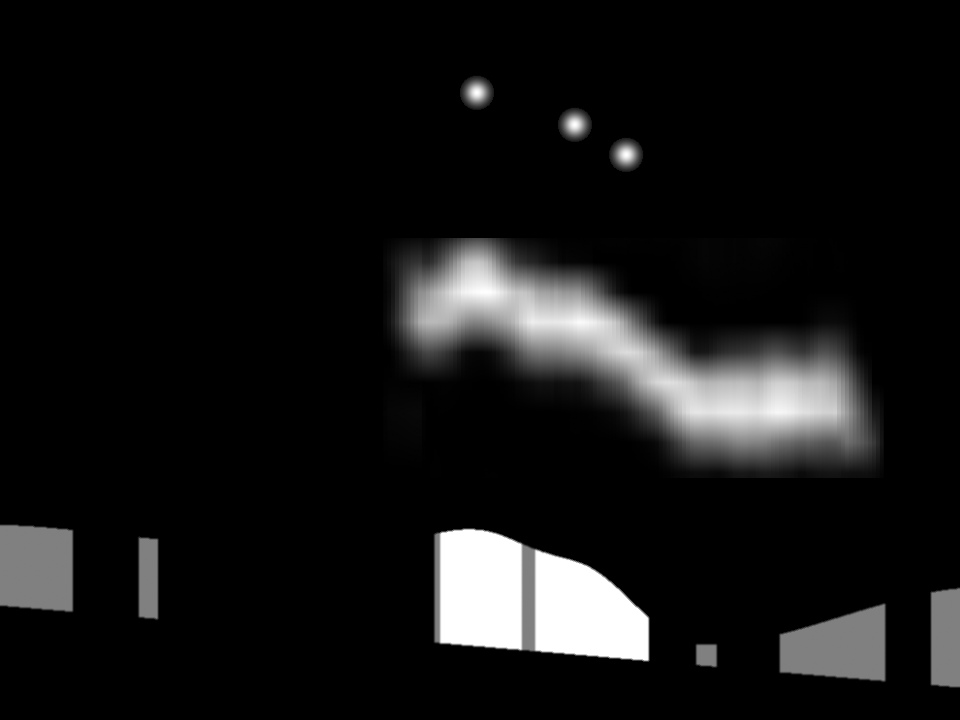
From the sparse baseline annotations we generate two novel pseudo-label sets, each designed to give a segmentation model a richer signal to train on.
Training
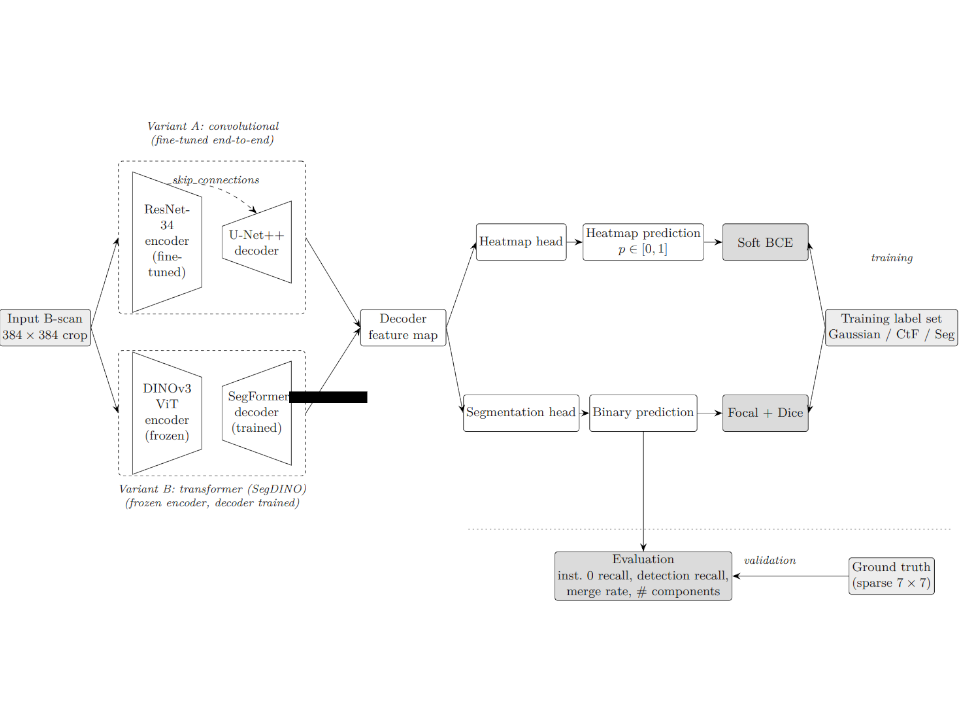
The two pseudo-label sets, plus a gaussian representation baseline built from the original annotations, drive a wide range of segmentation experiments across multiple model architectures.
Results
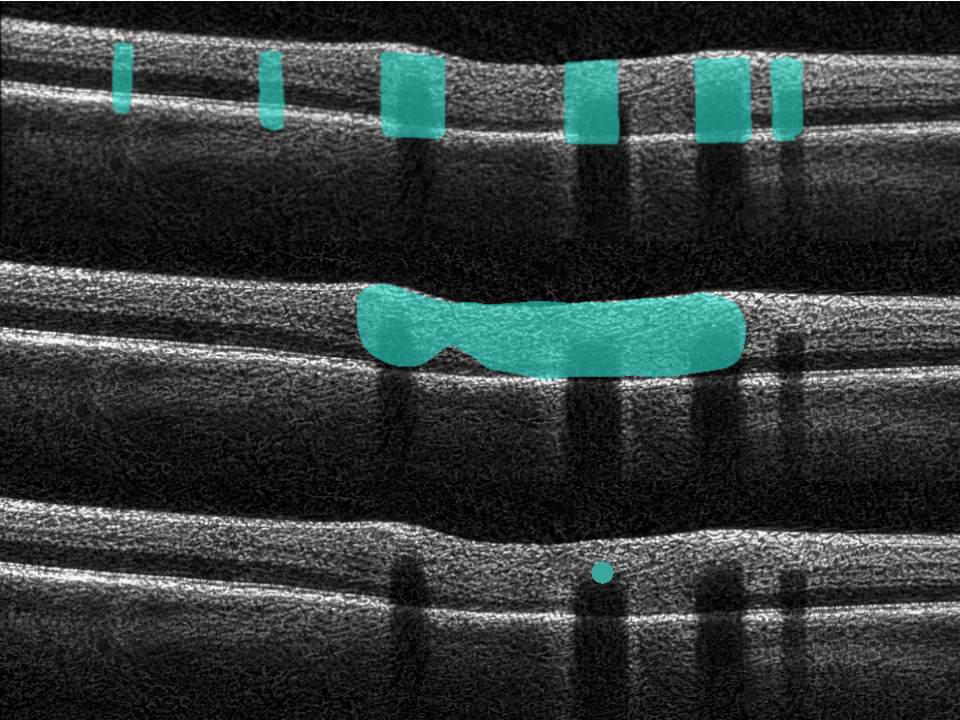
The best approach lifts instance-level recall from 0.589 to 0.909 and detects over three times as many vessels. Reliable evaluation, however, remains out of reach without a dense ground-truth reference.
Solution developed and its benefits
Our solution is to transform these sparse point annotations into denser, richer training targets, so-called pseudo-labels, that give a model a far stronger signal to learn from without requiring any additional manual annotation.
- denser supervision generated automatically from the existing sparse annotations
- two complementary pseudo-label schemes, a coarse-to-fine and an anatomy-guided approach
- a clear improvement in vessel detection over the sparse baseline
- instance-level recall raised from 0.589 to 0.909
- more than three times as many vessels detected
- an evaluation protocol built around instance-level metrics suited to sparse ground truth
- a characterisation of how each label set fails, informing which approach to trust
- a reusable pipeline spanning label generation, training, and evaluation
The most important insight of the work extends beyond the models themselves. Under sparse supervision, no evaluation available to us can conclusively prove which approach is best, as every metric is measured against an incomplete reference. The binding constraint has therefore shifted from model capacity to the evaluation itself, which points to the clearest next step: a small, densely annotated reference set against which future approaches could finally be compared without ambiguity.
Key terms
- LanguagePython
- LibrariesPyTorch, NiBabel, numpy
- Keywordsretinal vessel segmentation, optical coherence tomography, sparse annotation learning, pseudo-labels, pseudo-label generation, sparse annotations, coarse label learning, CNNs, foundation models, Grad-CAM
Customer

Basel University Hospital, Eye Clinic
Philippe Valmaggia
Peter Maloca
4001 Basel
Link to Basel University Hospital, Eye Clinic