
Could Serum Gut Microbiome Metabolites become Potential Biomarkers for Alzheimer's Disease?
Serum gut metabolites were investigated as early predictors of Alzheimer's disease using longitudinal data from over 1,200 participants in the ADNI cohort, applying statistical models and machine learning to identify metabolic patterns linked to disease progression.

Initial situation
Alzheimer's disease (AD) is a progressive neurodegenerative disorder, affecting more than 57 million people worldwide and placing a significant burden on healthcare systems. Early and reliable diagnosis remains a major challenge, as current methods depend on expensive neuroimaging procedures or invasive biomarker testing. Emerging research into the gut–brain axis suggests that gut-derived metabolites measurable in blood serum may offer a non-invasive window into neurological health. If specific serum metabolites reliably associate with Alzheimer's disease or its early stages, they could serve as non-invasive, cost-effective biomarkers.
Problem statement
While the gut–brain axis is gaining attention in AD research, the predictive value of specific serum metabolites remains poorly understood. The Alzheimer's Disease Neuroimaging Initiative (ADNI) provides a rare longitudinal dataset with metabolomics data from hundreds of participants with known diagnosis trajectories spanning normal cognition (NL), mild cognitive impairment (MCI), and Alzheimer's disease (AD). However, modelling this data presents several challenges: the high dimensionality of 107 metabolite features, repeated measurements per participant over years, class imbalance between diagnostic groups, and the need to detect subtle progression from MCI to AD rather than only established disease.
Project goal
This thesis analyses serum gut metabolites from the ADNI longitudinal cohort to identify metabolic profiles associated with Alzheimer's disease and cognitive decline. Using linear mixed models (LMMs) to account for repeated measures and covariates such as age and sex, followed by machine learning classifiers including Support Vector Machines and a Cascaded Random Forest Classifier with group-aware cross-validation, the project aims to determine whether gut metabolites — alone or combined with cognitive test scores — can distinguish diagnostic groups and predict disease progression.
Significant Serum Gut Metabolites
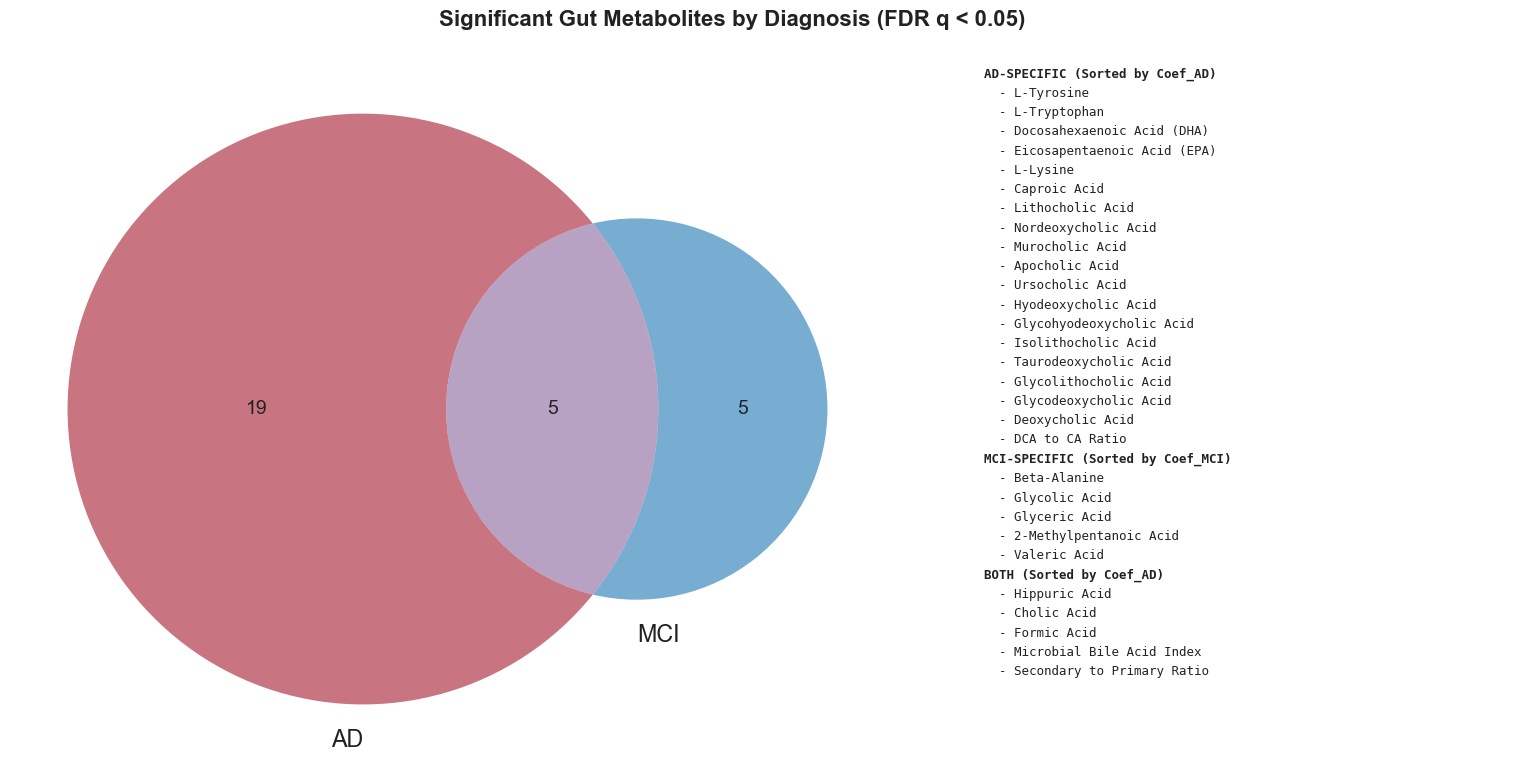
Linear mixed models with FDR correction identified serum gut metabolites significantly associated with Alzheimer's disease and MCI. Bile acid derivatives emerged as particularly relevant markers, pointing to alterations in gut microbial metabolism as a potential contributor to AD pathology.
Diagnosis Classification
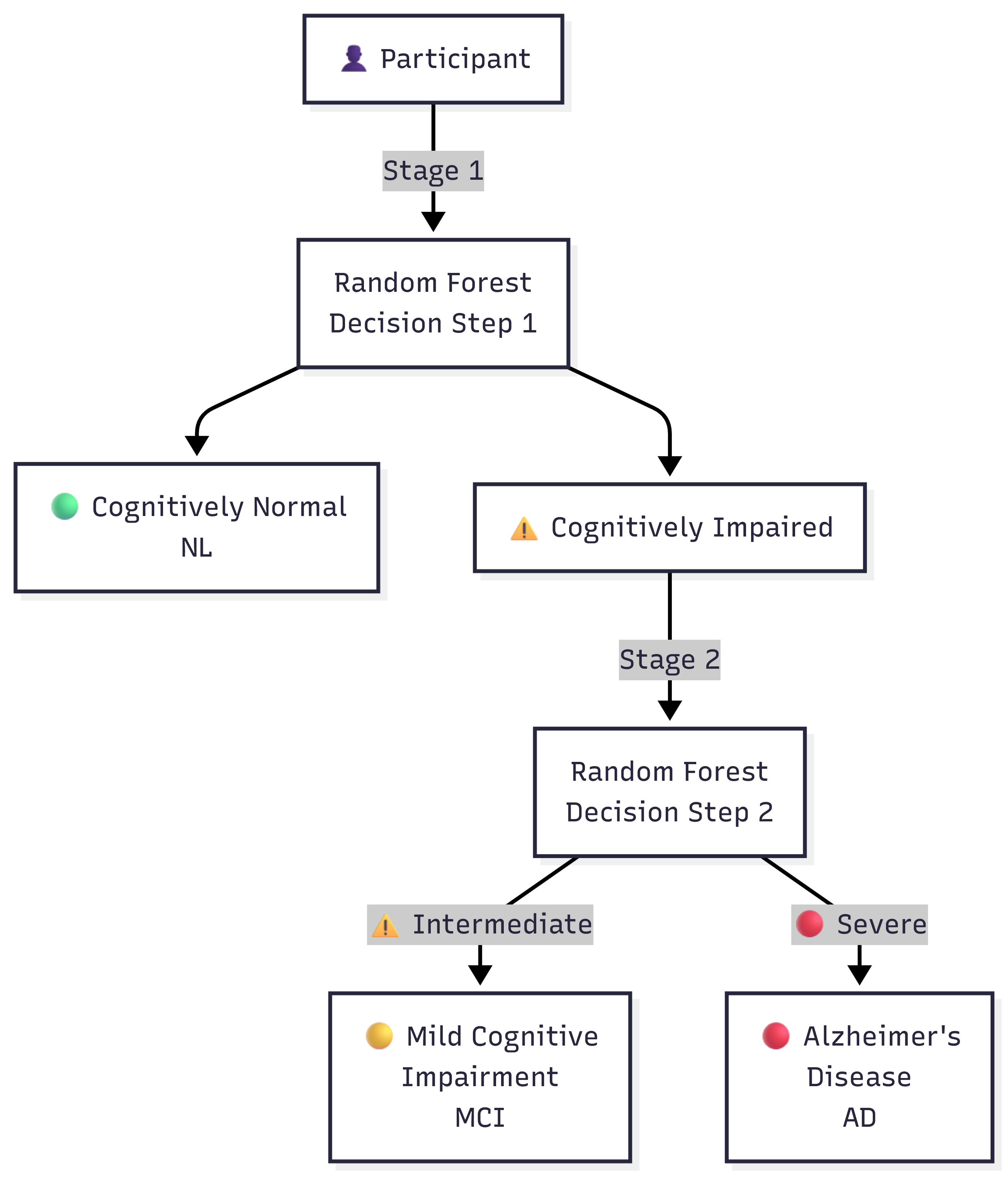
A Cascaded Random Forest Classifier was trained to distinguish between normal cognition (NL), mild cognitive impairment (MCI), and Alzheimer's disease (AD), using metabolite features alongside cognitive test scores. It achieved an average precision of 0.90 for MCI and 0.84 for AD, with an overall accuracy of 0.87.
Predicting Converters from MCI to AD
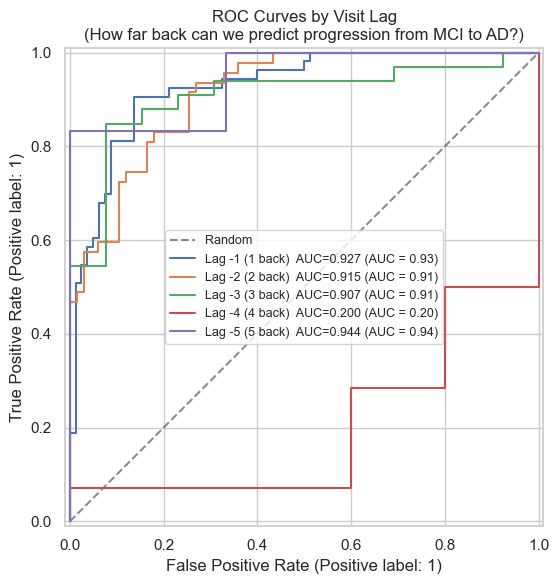
A Support Vector Machine trained on serum gut metabolites and cognitive scores was able to identify participants who later converted from MCI to Alzheimer's disease with 87% accuracy and 94% recall. The predictive signal emerged 12 to 27 months before the actual change in diagnosis.
Results and their significance
Linear mixed models with Benjamini–Hochberg FDR correction identified a subset of serum metabolites significantly associated with Alzheimer's disease and MCI after controlling for age, sex, and repeated measurements per participant. Several bile acid derivatives showed differential levels across diagnostic groups. Glyceric acid, a metabolite involved in energy homeostasis and oxidative stress regulation, was found to be slightly elevated in MCI, potentially reflecting early metabolic dysregulation. Hippuric acid, a gut microbiome-derived metabolite reflecting microbial processing of dietary polyphenols, showed reduced levels in both MCI and AD, suggesting a progressive decline in gut microbiome diversity and activity across the disease spectrum.
- Significant serum metabolites associated with AD and MCI identified via linear mixed models with FDR correction
- Bile acid ratio emerged as a particularly relevant metabolic marker distinguishing diagnostic groups
- SVM classifier using metabolite features and cognitive test scores achieved meaningful classification performance
- Group-aware cross-validation ensured participant-level data integrity and prevented leakage across repeated visits
- Results support the hypothesis that gut metabolite profiles carry relevant signal for Alzheimer's disease risk stratification
Although serum gut metabolites show statistically significant associations with Alzheimer's disease, the effect sizes observed with the current sample availability are modest. A key limitation is that they are deeply intertwined with other biological mechanisms, making them uninformative in isolation. The same metabolite concentration may be protective in one constellation of circumstances and harmful in another. Their real contribution emerges in combination: when gut metabolite profiles are paired with cognitive test scores, classification performance improves substantially, with each modality capturing signal the other misses. This suggests that metabolites are not a standalone biomarker, but a valuable complementary layer in a multimodal approach to early Alzheimer's risk assessment.
Key terms
- Alzheimer's DiseaseA progressive neurodegenerative disorder and the leading cause of dementia, characterised by cognitive decline, memory loss, and structural changes in the brain.
- Gut–Brain AxisThe bidirectional communication network between the gastrointestinal microbiome and the central nervous system, influencing neurological health.
- MetabolomicsThe large-scale study of small molecules (metabolites) produced by cellular processes, analysed here in blood serum samples from the ADNI cohort.
- ADNIThe Alzheimer's Disease Neuroimaging Initiative is a multisite longitudinal study providing neuroimaging, biomarker, cognitive, and clinical data used in this project.
- Linear Mixed ModelsStatistical models accounting for both fixed effects (diagnosis, age, sex) and random effects (repeated measures per participant), enabling robust analysis of longitudinal data.
- Machine LearningComputational classification approaches that include Support Vector Machines and a Cascaded Random Forest Classifier were applied to predict disease stage and MCI-to-AD progression from metabolomics and cognitive features.
- Bile Acid RatiosRatios between primary and secondary bile acids produced by gut bacteria, reflecting the composition and activity of the gut microbiome and emerging as particularly relevant metabolic markers in this analysis.
- DysbiosisAn imbalance in the composition of the gut microbiome, associated with altered metabolite production and linked to systemic inflammation and neurological conditions including Alzheimer's disease.
Team
Katarina Fatur
Advisors
Prof. Dr. Arzu Çöltekin
Dr. Laura Fontanesi