
DeliriumVR II
A first-person VR simulation that builds empathy for delirious patients by letting users experience the same hospital scenario twice — once as a nurse making care decisions, and once as the patient living with the consequences.

Initial situation
Delirium is an acute state of mental confusion affecting nearly one-third of hospitalized elderly patients, yet it remains one of the most underrecognized clinical conditions in healthcare. Its symptoms — visual and auditory hallucinations, temporal disorientation, paranoia, altered perception of reality — are largely invisible to observers and are frequently misinterpreted by both healthcare professionals and family caregivers. Mishandled interactions can directly worsen a patient's mental state, while caregivers report significant symptoms of anxiety and helplessness when confronted with a delirious episode. The challenge is not only clinical knowledge, but empathy: the capacity to genuinely understand what the patient is experiencing from the inside.
Problem statement / Project goal
Existing VR medical training platforms are built around procedural competence — teaching clinicians how to perform tasks correctly under pressure. Very few address empathy as a primary design goal, and none offer an experience where a user's caregiving decisions directly shape the patient's subjective experience. This project, initiated by Dr. med. Mathias Schlögl of the Barmelweid clinic, set out to close that gap. The goal was to develop a VR simulation for healthcare professionals, caregivers, and family members that makes the consequences of caregiving behaviour immediately and viscerally felt — through a dual-perspective structure unique in the field of delirium training.
The Nurse Phase
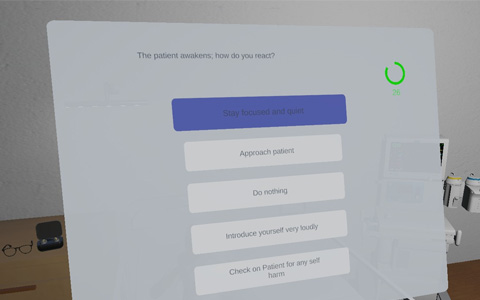
The user takes the role of a nurse navigating five care decisions under time pressure. Each choice — how to communicate, whether to reorient or correct, how to respond to agitation — is grounded in clinical best practice and validated by Dr. med. Schlögl.
The Patient Phase
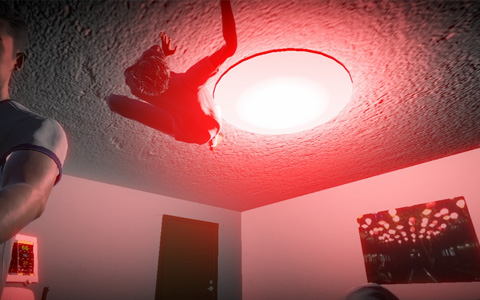
The same scenario replays from the patient's point of view. Hallucinations — representing fear, helplessness, confusion, out-of-body experience, and distortion — activate in direct response to the quality of the earlier decisions. Wrong choices lead to more intense experiences.
Standalone Mocap App
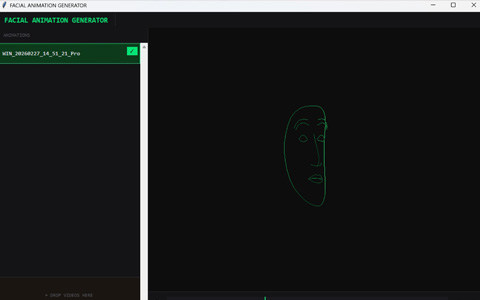
A companion Windows application was developed alongside the simulation. It takes a standard webcam feed, processes facial landmarks via Google MediaPipe, and exports a Unity-importable .anim file — no specialist hardware required. Custom ARKit-to-Character Creator blendshape mappings make it usable with a range of 3D models.
Solution developed and its benefits
DeliriumVR II is a standalone Meta Quest application developed in Unity (URP) using C#. The simulation is structured around Unity's Timeline system, which enabled precise choreography of animation, audio, decision trigger points, and hallucination effects in a cinematic, non-interactive format — deliberately chosen so that VR-inexperienced users can engage without distraction. The experience runs at a stable 65 FPS on standalone hardware.
- First dual-perspective delirium simulation: nurse phase decisions directly determine patient-phase hallucinations
- Runs fully standalone on Meta Quest — no PC or external hardware required
- Five clinically grounded decision points covering distinct aspects of delirium care
- High-fidelity character avatars with ARKit-driven facial motion capture
- Modular timeline architecture — clinical content can be updated without engineering changes
- Companion standalone Windows application for generating facial animations from webcam input, usable by non-technical users
The feedback loop between the nurse phase and the patient phase is what distinguishes DeliriumVR II from anything currently available in this space. Existing competitors such as HDmedical's DelTrain present the patient perspective in a largely stationary, single-viewpoint format. DeliriumVR II creates a direct causal link: the user sees the outcome of their own behaviour, rendered through the hallucinations the patient experiences. Research on VR empathy training consistently finds that this combination of immersion, perspective-taking, and meaningful interactivity produces stronger and more lasting empathic outcomes than passive observation alone.
Key terms
- DeliriumAcute mental confusion affecting ~1/3 of hospitalized elderly patients; characterized by hallucinations, disorientation, and fluctuating awareness
- Virtual Reality (VR)Immersive, head-mounted display-based simulation conveying a first-person experience with a strong sense of presence
- Dual PerspectiveCore design feature: the user experiences the same scenario sequentially as nurse and as patient
- EmpathyCognitive and affective capacity to understand a patient's inner experience; primary design goal of the simulation
- Meta QuestStandalone VR headset targeted by the simulation; no PC required
- Unity / URPGame engine and rendering pipeline used for development
- ARKit / Motion CaptureTechnology for recording facial and body animations from standard video input
- Character Creator 5Tool used to create high-fidelity, ARKit blendshape-compatible character models
Customer
Barmelweid Clinic
Dr. med. Mathias Schlögl
Thomas Kunz
Barmelweid 5
5017 Barmelweid
www.barmelweid.ch
Team
Shane Zulauf
Joshua Brehm
Advisors
Arzu Cöltekin
Laura Fontanesi