
Sharing digital content and controlling visibility in mixed reality
Initial situation
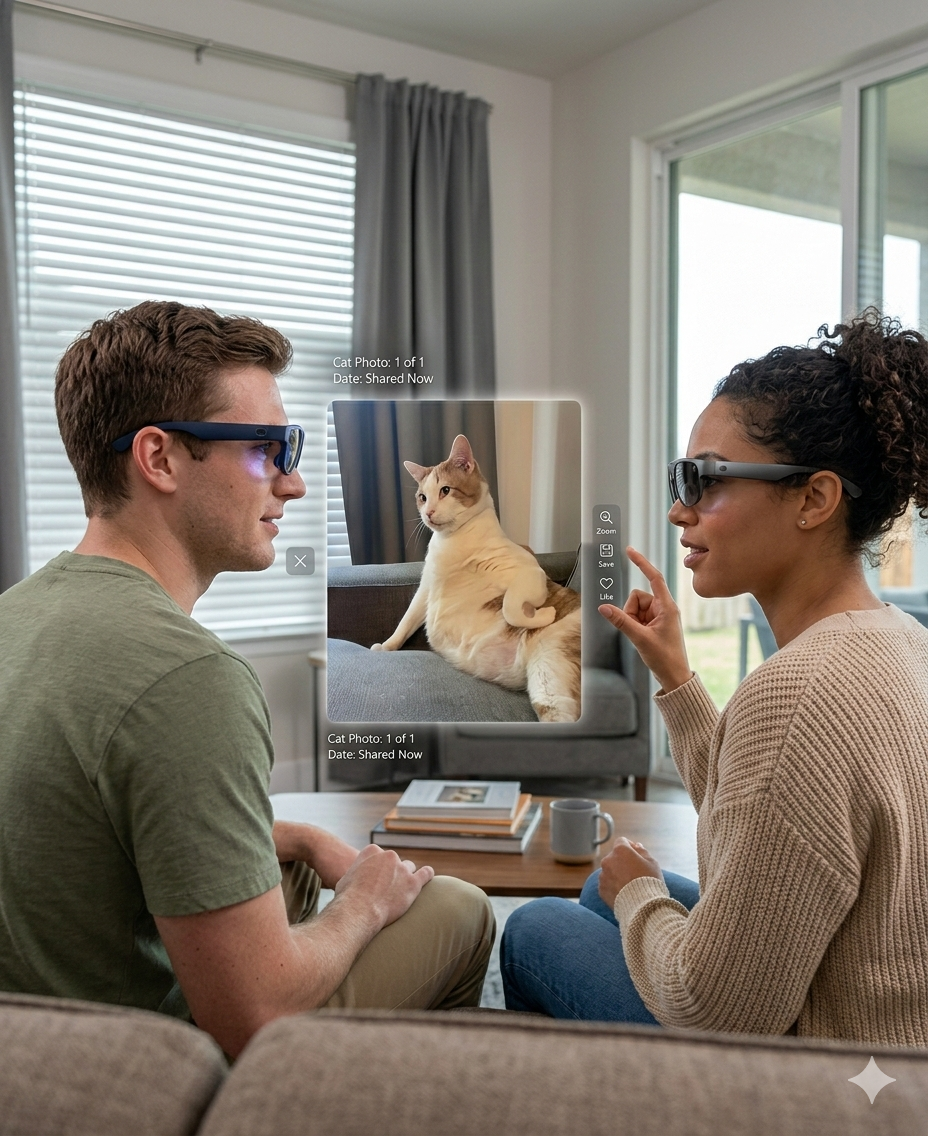
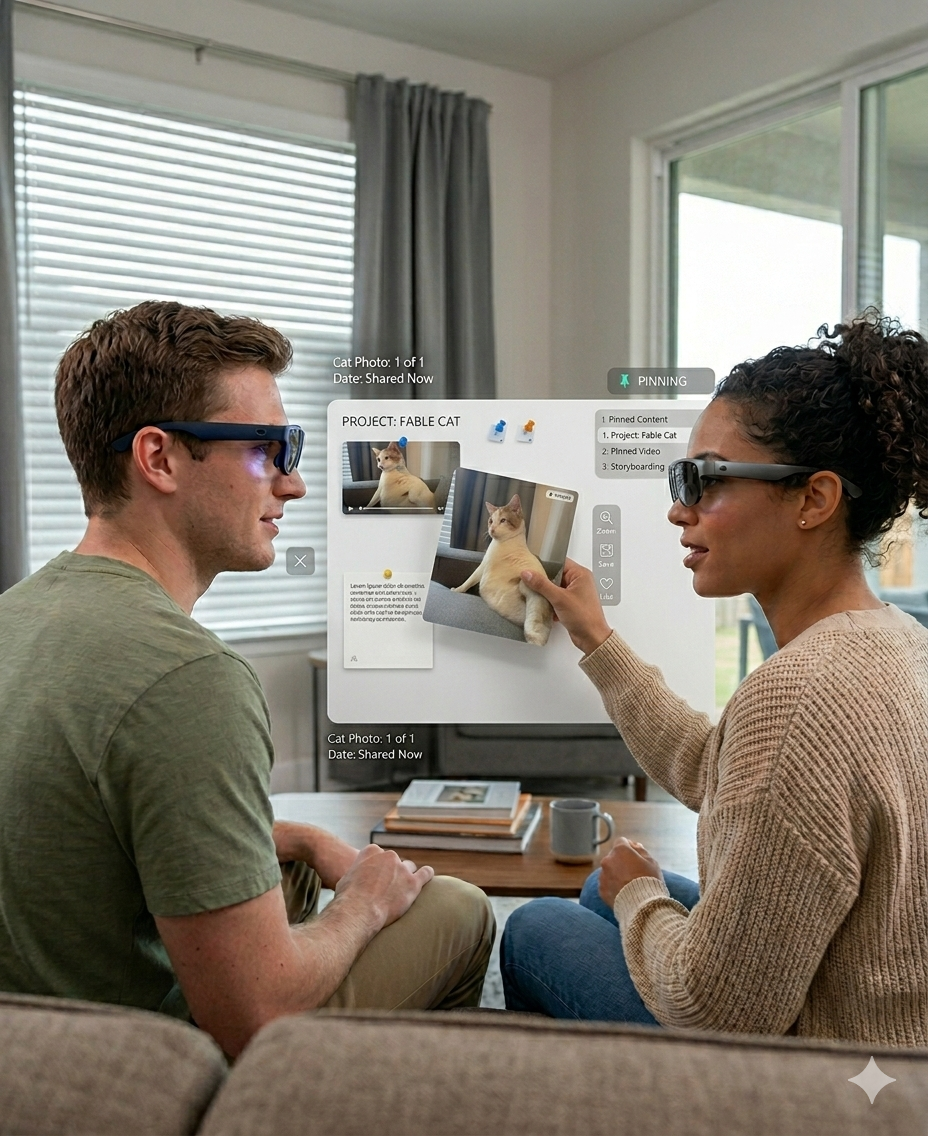
Mixed Reality (MR) enables co-located collaboration where users can place and view digital content such as images, videos, or 3D objects in their shared physical space. However, current solutions often provide limited support for targeted visibility control. As a result, users may not clearly understand who can see what content, when it becomes visible, and how access can be revoked.
Problem statement and project goal
This project developed and evaluated interaction concepts that enable MR users to share digital content while maintaining transparent and privacy-aware visibility control in co-located multi-user settings. The goal was to design and implement interaction concepts that feel intuitive, provide clear feedback about visibility outcomes, and support socially acceptable use in real-world environments.
Sharing content - Scenario one
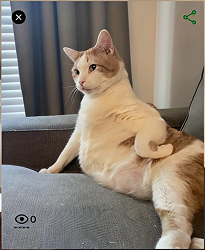
Sharing interaction in scenario one was designed based on existing digital workflows and already familiar icons for sharing activity.
Sharing content - Scenario two
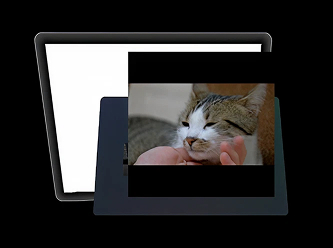
Sharing interaction in scenario two was a more abstract approach by implementing a natural interaction with the shareable objects.
Sharing content with icons
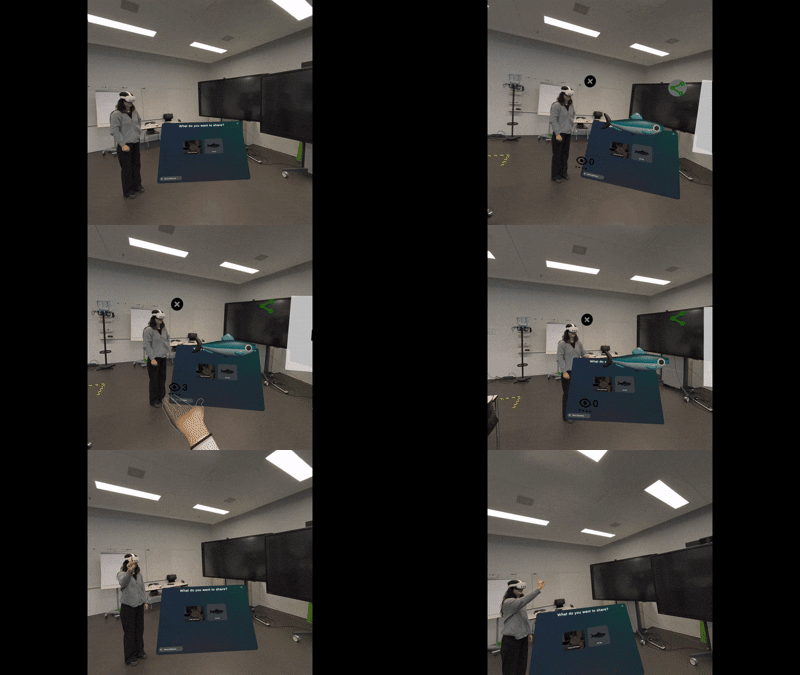
Scenario one focused on sharing content in a one-to-one setting where users can choose the receiver from a list of selectable users. Shared content is only visible for the person that is sharing and for the selected receiver.
Placing content on whiteboard
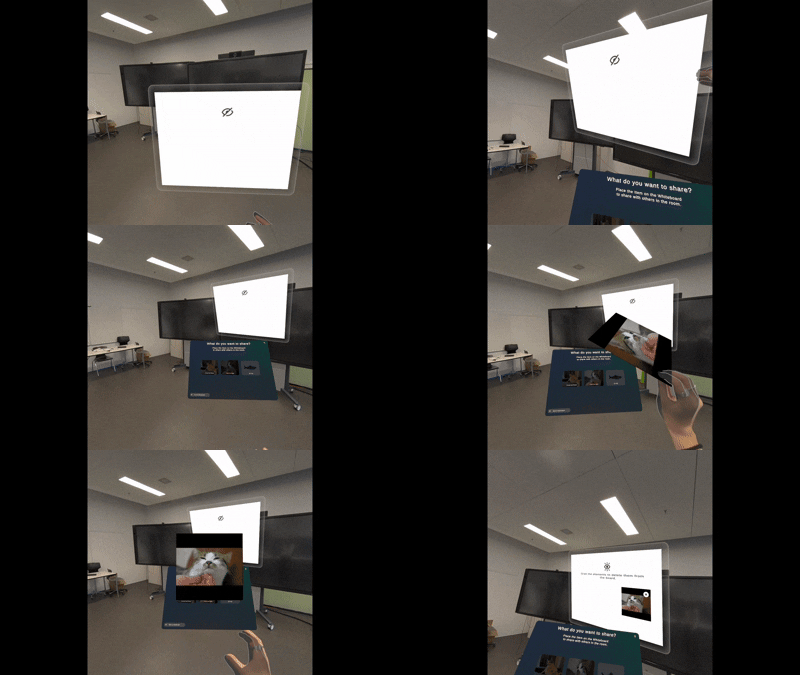
Scenario two focused on sharing content to a public surface where all users in the environment were able to see the same content simultaneously. Placing content can be done by naturally grabbing the items and placing them onto a shared whiteboard surface.
Solution developed and its benefits
Two complementary prototypes were designed and implemented to explore privacy-aware content sharing in co-located MR. Scenario one supports directed one-to-one sharing by selecting a specific recipient. Scenario two supports public group sharing by placing content onto a shared whiteboard that is visible to all participants.
Key benefits
- Supports private one-to-one sharing
- Supports one-to-many sharing
- Clear visibility cues help users understand who can see content
- Supported content types: 2D images, videos, and selected 3D objects
The concepts were evaluated in a usability test. Results indicated that both scenarios were easy to understand, but perceived trust and intuitiveness strongly depended on immediate and unambiguous feedback confirming the visibility outcome of each action.
The outcome of this Bachelor's thesis suggested that future MR sharing systems should treat visibility control as a firstclass design and platform concern rather than application-level detail, particularly when aiming to support privacy-aware sharing in real multi-user contexts.
Technologies
The application was developed in Unity (C#) for Meta Quest 3. It is based on Meta’s MR Motifs for passthrough blending, instant content placement, and co-location building blocks. For networking, Photon Fusion 2 was integrated. Hand tracking and interaction were implemented using the Meta XR Core SDK and Meta XR Interaction SDK.
Key terms
- Mixed realityMixed reality blends digital objects with the real world so they can interact in real time.
- Interaction designDesigning user actions and feedback so that sharing and visibility control are understandable and efficient.
- MR MotifsA Meta-provided toolkit of reusable Unity building blocks for rapid MR prototyping.
- Visibility controlMechanisms that define and communicate who can see specific digital content and when access can be revoked.
- Digital content sharingSharing images, video, or 3D objects between users in one-to-one and one-to-many MR situations.
- Usability testingEvaluating how effectively and intuitively users can complete tasks, supported by structured questionnaires and observations.
Customer
Institute of Interactive Technologies
Prof. Dr. Kevin Gonyop Kim
Bahnhofstrasse 6
CH-5210 Windisch
www.fhnw.ch
Team
Livia Stöcklin
Luca Bravo
Advisor
Prof. Dr. Kevin Gonyop Kim