
Data4Workers
A browser-based, privacy-preserving dashboard that helps platform workers upload, explore, and understand their personal work data (e.g., Uber Eats and Babysits) through clear, interactive visualizations.
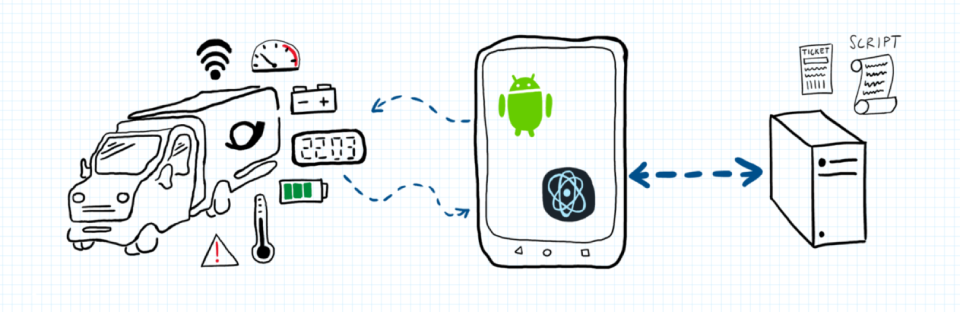
Initial situation
Digital labor platforms such as Uber Eats and Babysits capture detailed traces of workers activities—hours, jobs, earnings, and performance indicators. While platforms can use this data to manage work and pay, workers typically receive limited transparency and often only get access to raw exports (e.g., via GDPR data access), which are difficult to interpret without technical skills.
Existing initiatives like the Digipower Academy show that local (client-side) data processing can enable privacy-friendly exploration of personal data, but worker-specific metrics and navigation still require improvements to support autonomous use—especially on mobile devices.
Problem statement / Project goal
The goal of Data4Workers is to close the gap between “having access” to platform data and “being able to make sense of it.” The project improves the navigation workflow for independent upload and exploration, and implements worker-centered visualizations that make common gig-work questions easier to answer, such as: When do I work? How much do I earn? Which days or shifts are most profitable? How is my time distributed?
Impression 1
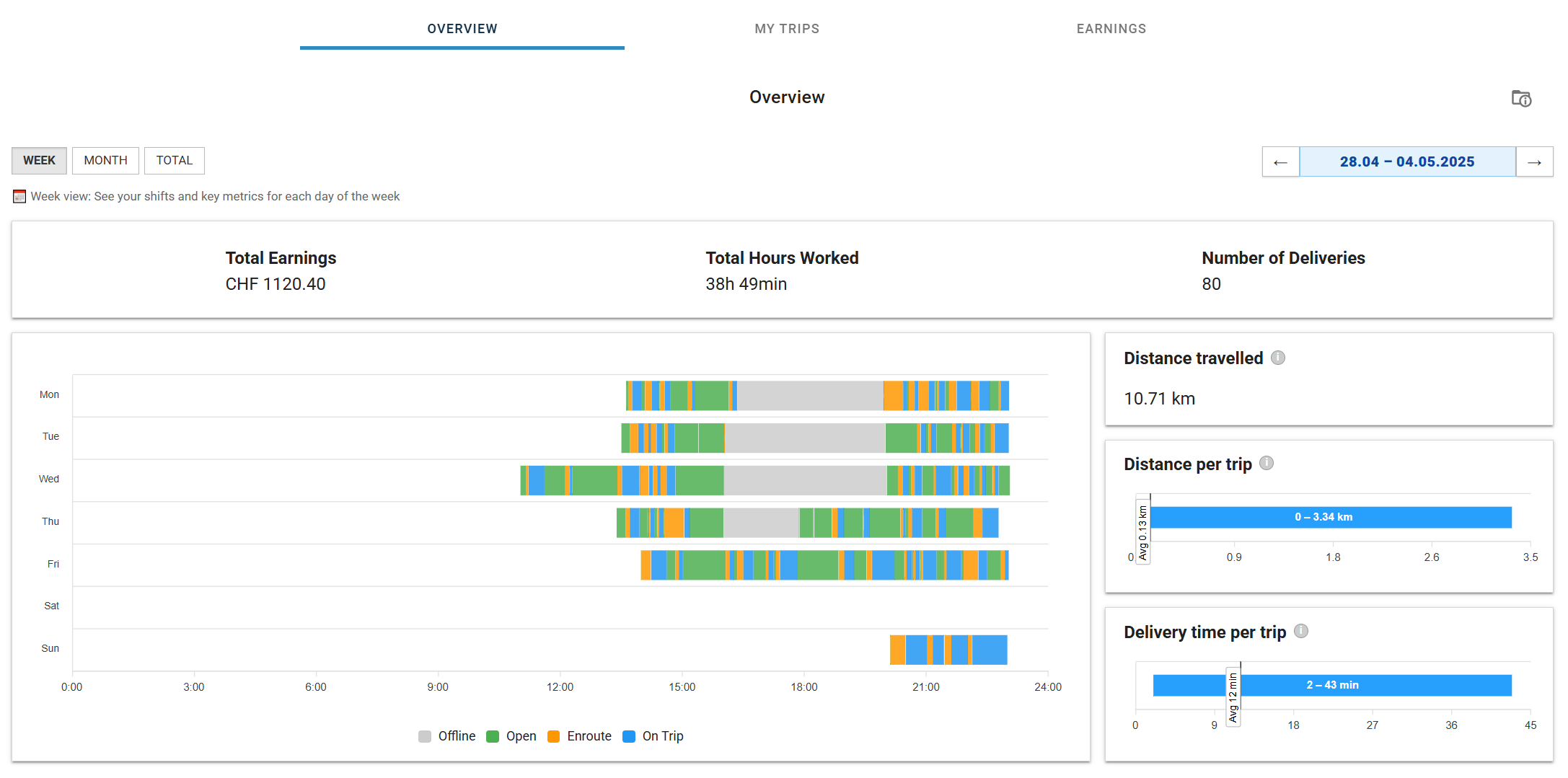
Uber Eats “Overview” dashboard: key metrics for the selected period plus weekly/monthly/total navigation to analyze work rhythm, deliveries, distance, and earnings.
Impression 2
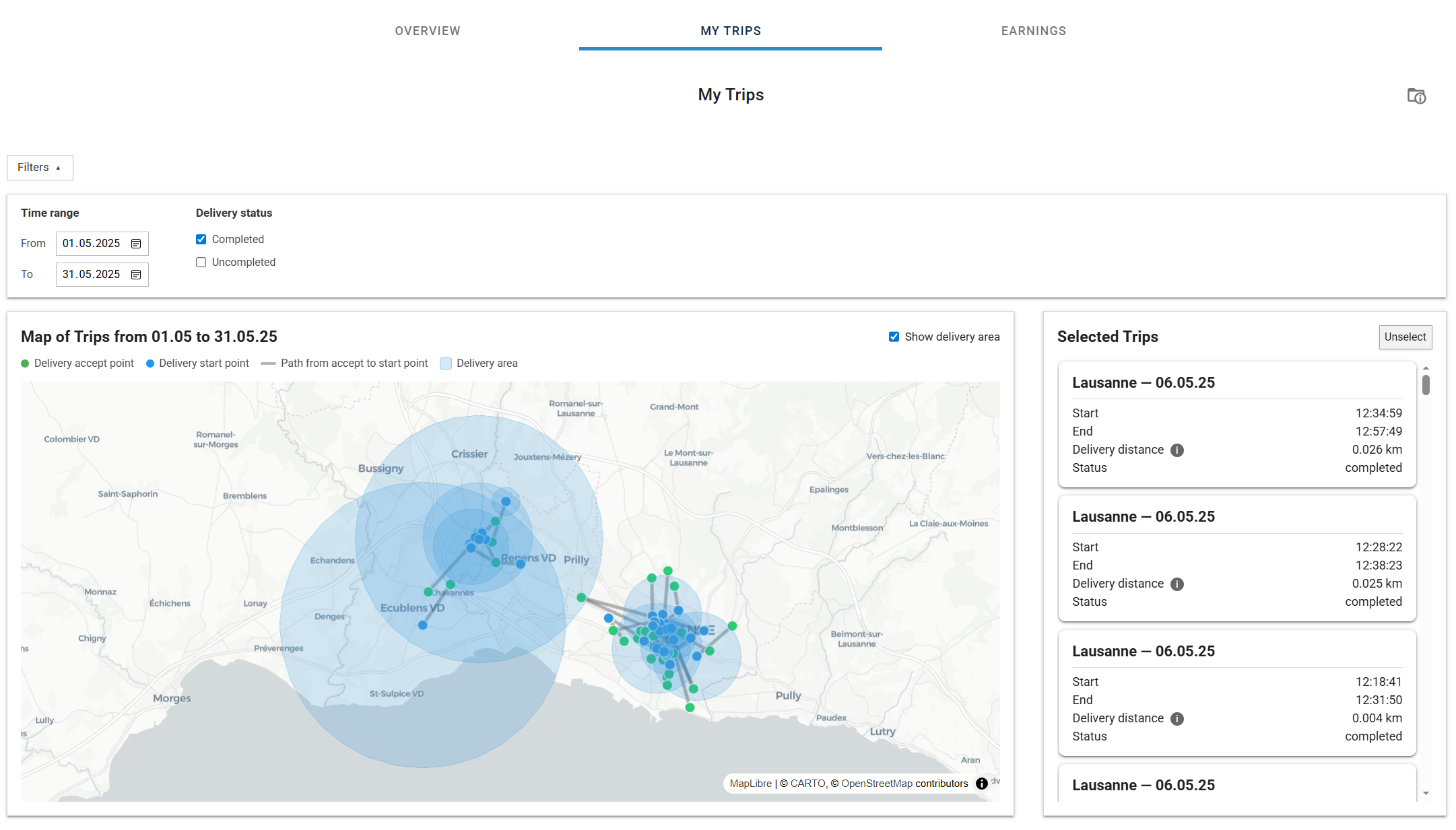
Uber Eats “My Trips” view: filterable trip list combined with a map visualization of routes (privacy-aware: showing start/end points and approximate areas).
Impression 3
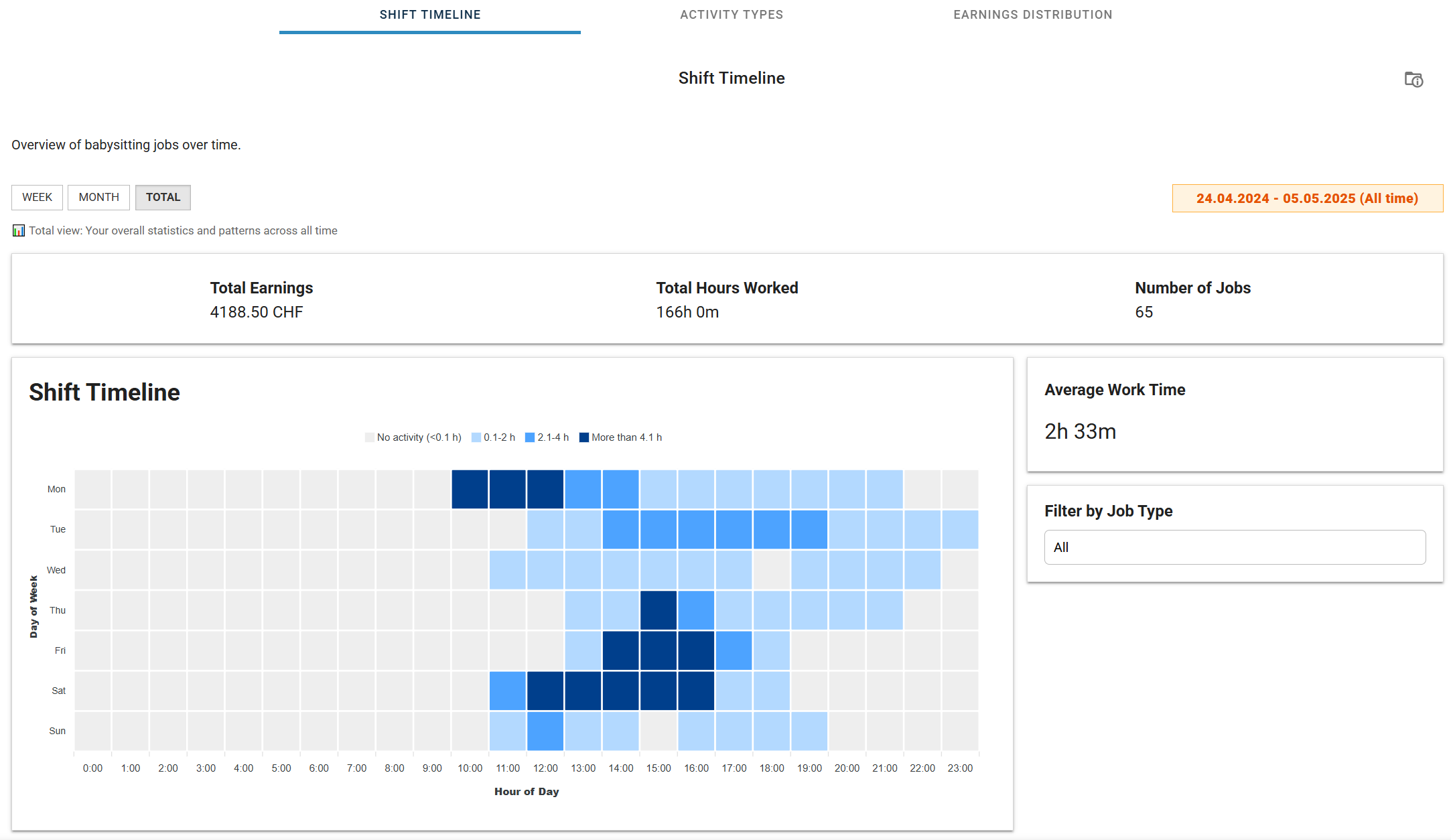
Babysits “Shift Timeline” view: Gantt-like timeline (weekly), calendar-style exploration (monthly), and a heatmap summary (total) to reveal long-term working patterns.
Solution developed and its benefits
Data4Workers extends the Digipower experience framework with two worker-focused experiences (Uber Eats and Babysits). Users can upload their own platform export (e.g., ZIP/CSV), and the application transforms the raw files into interactive views, entirely inside the browser, to preserve privacy and user control. It has following benefits:
- Autonomous upload & exploration: improved navigation and clear workflow from upload → insights.
- Multiple time scales: weekly, monthly, and total views to move from detail to long-term patterns.
- Worker-centered metrics: earnings, hours worked, completed jobs, activity types, routes/trips.
- Exploratory + explanatory design: quick summaries plus interactive filters and detail-on-demand.
- Privacy by design: client-side processing; no external transfer required for analysis.
- Robustness: pipelines and UI are designed to handle incomplete or minimal datasets gracefully.
Technically, the system is implemented in the existing Digipower Vue.js codebase and integrates new experiences as modular packages with their own viewer configuration and browser-side data pipelines. Additional charting and time utilities are used where beneficial (e.g., for timelines and aggregations).
Key terms
- Platform workWork mediated by digital platforms with algorithmic management (tasks, pay, access).
- Client-side processingAll parsing, transformation, and visualization happen locally in the browser.
- Data experienceModular dashboard package inside the Digipower framework for a specific platform.
- UX navigation workflowInteraction design enabling autonomous upload and self-guided exploration.
- Time-based visualizationsWeekly timelines, monthly calendars, total heatmaps for work rhythm analysis.
- Geospatial visualizationTrip maps and route inspection for delivery data (privacy-aware).
- Data pipelinesTransform raw exports (CSV/ZIP) into normalized structures for charts and views.
- Usability & testingComponent tests, pipeline tests, performance tests, and moderated usability testing.
Customer

Client
Sofia Kypraiou
Institute of Sociology
University of Neuchâtel
Faubourg de l'Hôpital 27
2000 Neuchâtel
Team
Fabian Studer
Serhii Moshtakov
Supervisor
Dr. Prof. Anton Fedosov
Rahel Ganarin