
AI-based algorithms for energy-efficient control
Initial situation
Zurich Airport operates a large number of Heating, Ventilation and Air Conditioning (HVAC) systems that ensure thermal comfort and indoor air quality across multiple terminal buildings. These systems account for a significant portion of the airport’s total energy consumption and operational costs. Currently, many HVAC installations rely on conventional control strategies such as Proportional–Integral–Derivative (PID) controllers. While these controllers are robust and widely used, they primarily react to current system states and do not explicitly account for future disturbances, system dynamics, or interactions between control variables.
Problem statement / Project goal
Conventional HVAC control strategies, such as Proportional-Integral-Derivative (PID) controllers, operate primarily based on reactive feedback mechanisms. While these approaches are robust and widely used, they do not explicitly account for future disturbances, system dynamics, or interactions between multiple control variables. In large and complex buildings such as airport terminals, thermal behaviour is influenced by slow system dynamics, varying weather conditions, and fluctuating passenger occupancy. These factors can lead to delayed temperature responses and inefficient energy usage when controlled with purely reactive strategies. The goal of this project is to investigate the feasibility of a data-driven, optimisation-based control approach for HVAC operation at Zurich Airport. Using operational data from a pilot installation, a predictive model of the building’s thermal dynamics is developed and integrated into a Model Predictive Control (MPC) framework. The proposed control strategy aims to anticipate disturbances, optimise HVAC setpoints, and improve system performance. Its effectiveness is evaluated by comparing the MPC approach with the existing PID-based control strategy in terms of energy efficiency, thermal comfort, and control behaviour.
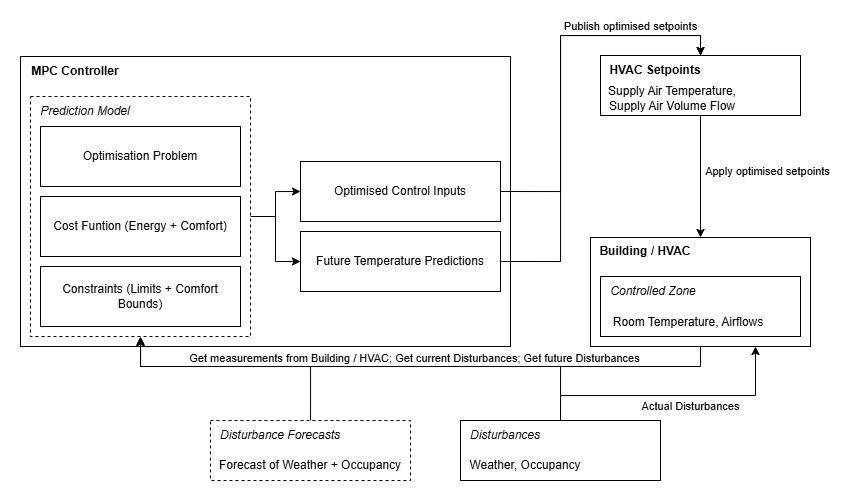
Conceptual closed-loop structure of an Model Predictive Control framework applied to Heating, Ventilation and Air Conditioning operation. Based on current measurements from the building system and forecasts of external disturbances such as weather and occupancy, the controller uses a predictive model to estimate future zone temperature behaviour. An optimisation problem is solved at each control step to minimise a cost function representing energy consumption and thermal comfort while respecting operational constraints. The resulting optimised control inputs are translated into Heating, Ventilation and Air Conditioning (HVAC) setpoints, such as supply air temperature and supply air volume flow, which are applied to the building system. After the control action is executed, new measurements are obtained and fed back to the controller, forming a receding-horizon closed-loop control process.
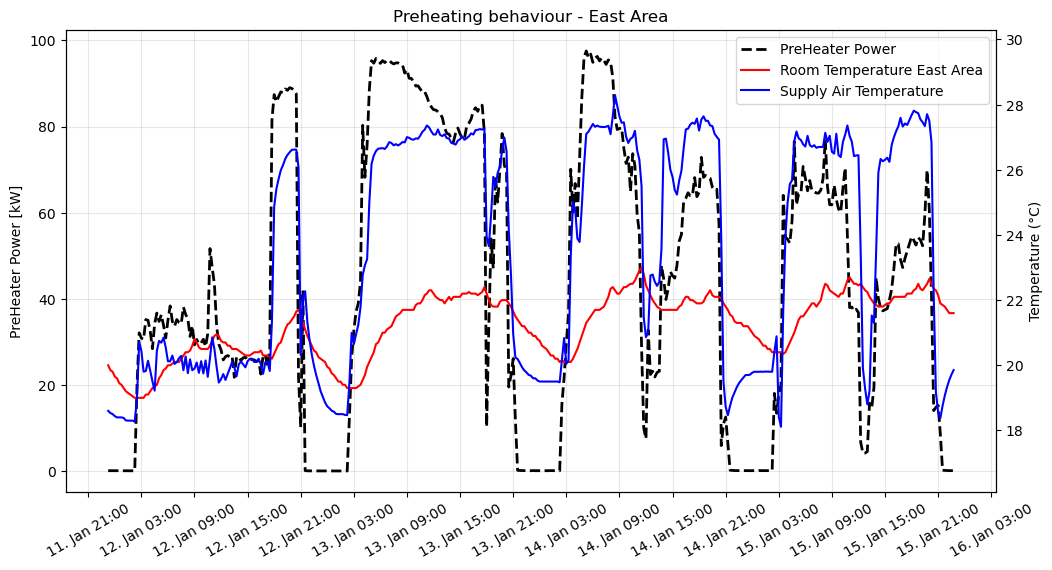
Showing preheater power, supply air temperature, and room temperature over a representative cold period. Increases in preheater power lead to a rise in supply air temperature, followed by a delayed increase in room temperature. The room-temperature response occurs gradually, indicating significant thermal inertia and a transport delay between heating actuation and zone-level temperature change. The relatively smooth and consistent response highlights stable thermal behaviour in the East Area, making it suitable for detailed analysis and controller tuning.
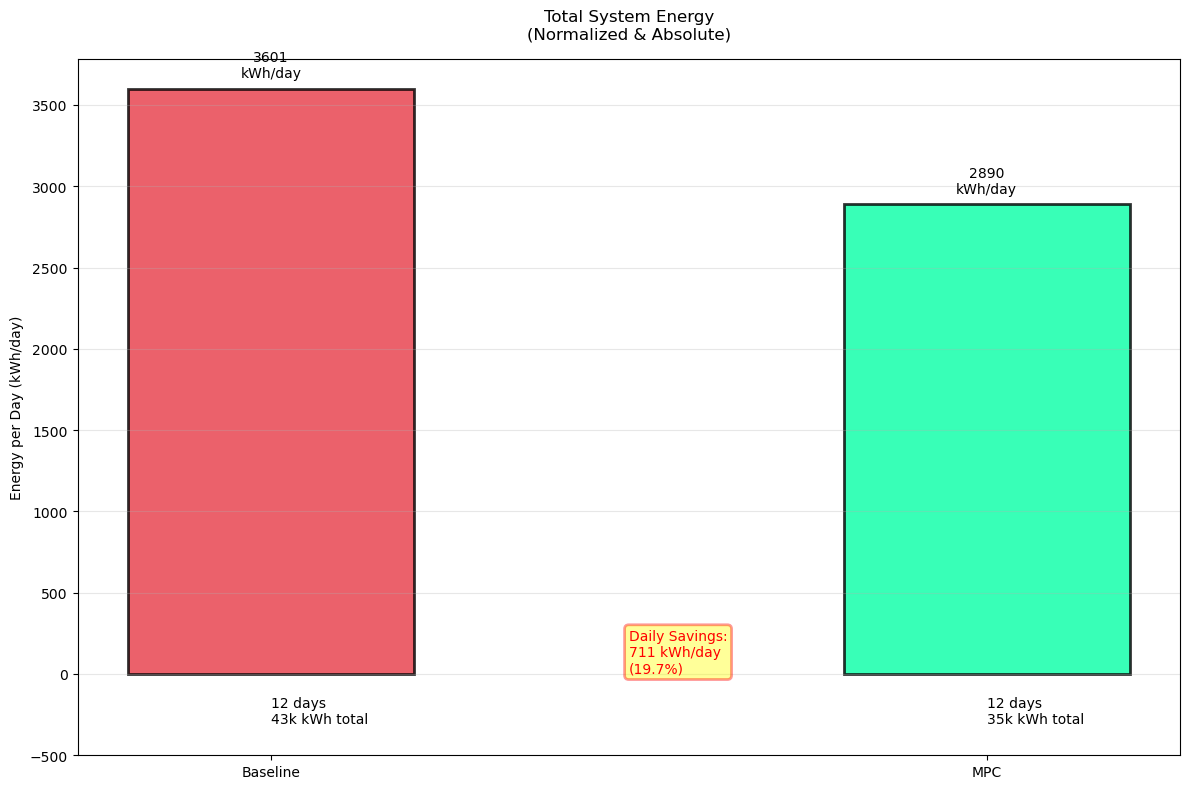
Total system energy consumption comparison. Baseline reference period consumed 3’601 kWh/day (43’174 kWh total over 12 days) compared to MPC 2’890 kW h/day (34’648 kWh total over 12 days). The MPC system achieves 711 kWh/day (20%) savings under matched operating conditions.
Solution developed and its benefits
A data-driven optimisation framework was developed to improve the energy efficiency and control performance of HVAC systems in airport buildings. The solution combines a predictive temperature model with a Model Predictive Control (MPC) algorithm that optimises HVAC setpoints such as supply air temperature and airflow. Using historical operational data, weather information, and passenger occupancy data, the system predicts future thermal behaviour and determines optimal control actions that maintain indoor comfort while reducing energy consumption.
- Reduces HVAC energy consumption through predictive optimisation
- Anticipates disturbances such as weather changes and occupancy variations
- Uses real operational data from airport building systems
- Scalable approach that can be applied to other large buildings
- Maintains stable indoor thermal comfort for passengers and staff
The developed approach uses a linear AutoRegressive model with exogenous inputs (ARX) to predict room temperature based on past measurements, control inputs, and external disturbances such as outdoor temperature and passenger occupancy. This predictive model is integrated into an MPC framework that calculates optimal HVAC control actions over a future time horizon while respecting operational constraints and comfort limits.
Evaluation using real operational data from a pilot Air Handling Unit at Zurich Airport showed that the predictive control approach can accurately capture the thermal dynamics of the building and enables anticipatory control behaviour. Compared with conventional reactive control strategies, the optimisation-based method improves system efficiency while maintaining thermal comfort in complex, large-scale HVAC environments.
Key terms
- HVAC OptimisationImproving heating, ventilation, and air conditioning system performance to reduce energy consumption while maintaining indoor comfort.
- Model Predictive Control (MPC)An advanced control method that predicts future system behaviour and calculates optimal control actions over a defined time horizon.
- ARX ModelA linear AutoRegressive model with exogenous inputs used to predict room temperature based on past measurements, control inputs, and disturbances.
- Predictive ControlA control strategy that anticipates future system states using mathematical models instead of reacting only to current errors.
- Thermal DynamicsThe way temperature in a building changes over time due to heating, cooling, weather conditions, and occupancy.
- Energy EfficiencyReducing the amount of energy required to operate HVAC systems while maintaining the same level of thermal comfort.
- Disturbance VariablesExternal factors such as outdoor temperature or passenger occupancy that influence the HVAC system but cannot be directly controlled.
Customer

Flughafen Zürich AG
Adrian Hausmann, Ronald Aeberhard, Amir Laouani
Postfach
CH-8058 Zürich-Flughafen
Flughafen Zürich AG
Team
Rehan Agarwal, Robin Schneider
Advisor
Simon Felix