
Optimisation of a VR-based OKAN Test with Eye Tracking for PPPD Diagnosis
We developed a VR-based OKAN test with integrated eye tracking to replace the traditional physical optokinetic drum. It is designed to improve PPPD diagnosis by increasing patient compliance, guiding operators through a clear workflow, and simplifying data analysis for experts.
Demonstration video of the OKAN-VR_V2.0 system showing the test workflow, patient view in VR, and automated report generation.
Initial situation
PPPD is a rare but complex vestibular disorder that is difficult to diagnose objectively. Current clinical practice relies mainly on patient self-reports, as standardised measurement tools are limited. The OKAN test — measuring eye movements after a rotating visual stimulus — shows promise as an objective method. The first VR prototype (OKAN-VR_V1.0) replicated this procedure virtually, but had shortcomings in patient compliance, operator usability, and the efficiency of data processing.
Problem statement / Project goal
The goal was to create OKAN-VR_V2.0, a VR-based medical test system that:
– Encourages patients to complete the test correctly, improving result quality.
– Guides operators through each step to reduce procedural errors.
– Automatically processes and visualises test data so experts can analyse results faster and more accurately.
Scene selection
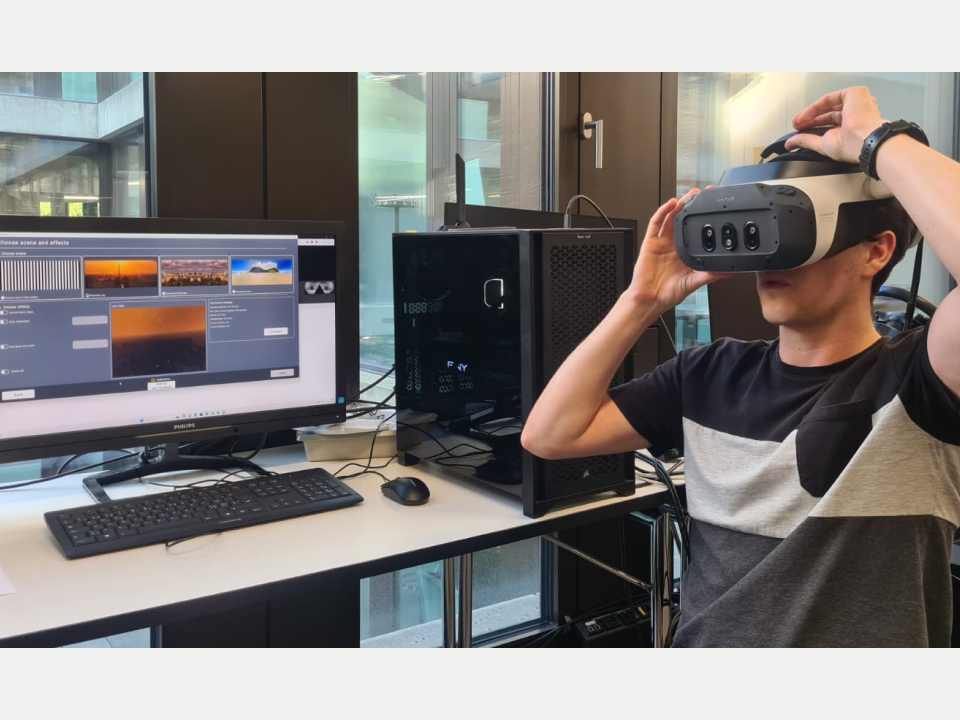
A test situation with a patient wearing the VR headset, while the operator configures the scene and effects on the control screen.
Running test
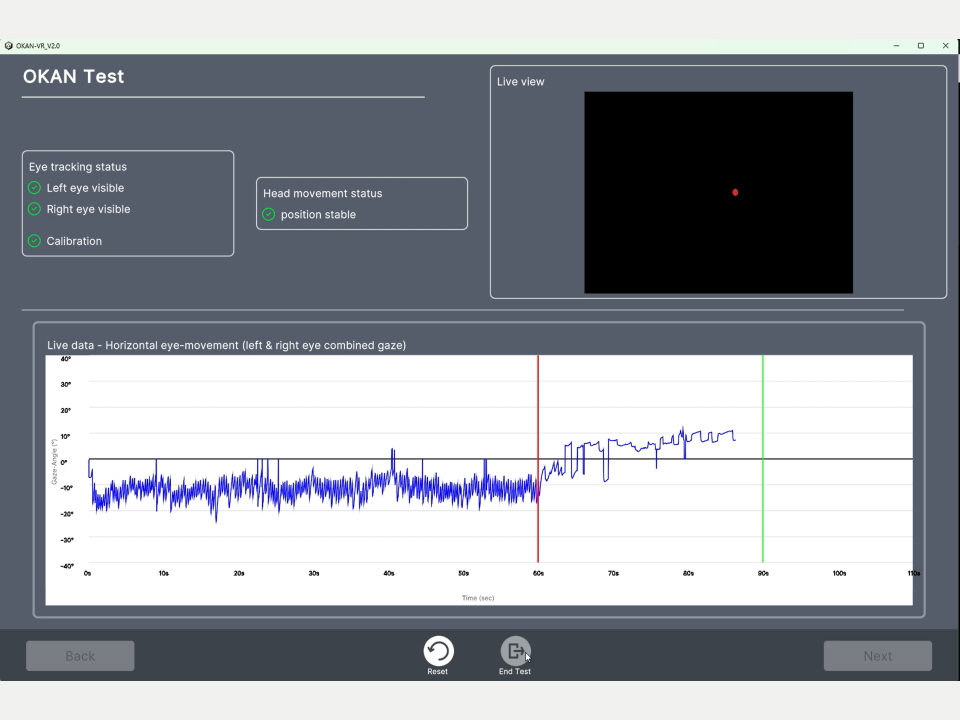
The running test shows the OKN phase (with visual stimulus) on the left and the OKAN phase (in darkness) on the right.
Test report
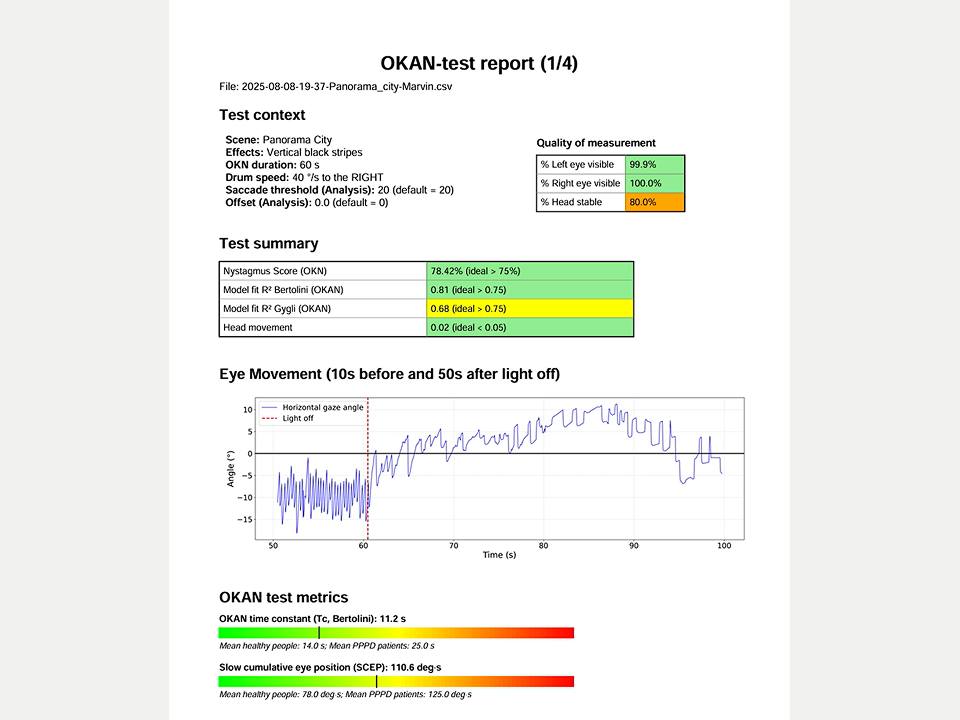
The automatically generated report summarises the data and offers detailed analysis options.
Solution developed and its benefits
Our application is a VR-based medical testing system that replaces the traditional physical optokinetic drum and is designed to support the diagnosis of PPPD. During the test, the patient wears a VR headset that displays a rotating scene, triggering optokinetic nystagmus (OKN). At a defined point, the scene fades to darkness, allowing the measurement of the optokinetic after-nystagmus (OKAN). Integrated eye tracking records these movements in real time. The operator uses an intuitive interface with a clear, guided workflow, can monitor exactly what the patient sees, and can intervene immediately if the patient makes a mistake — minimising invalid tests. Once the test is completed, the system automatically processes the data and generates a report. This report provides both a concise summary for quick assessment and detailed data views for in-depth analysis by medical experts.
- Redesigned operator interface to improve guidance and usability.
- Live patient monitoring to detect and correct mistakes during the test.
- Additional VR scenes optimised for comfort and measurement quality.
- Automated report creation to simplify and speed up data analysis.
- Reports providing both a quick summary and detailed data views.
Benefits: Higher rate of valid tests compared to the original prototype. Faster and simpler analysis for experts. Reduced patient burden by avoiding unnecessary repetitions. A ready-to-use platform for further clinical research and refinement of PPPD diagnostic parameters.
Key terms
- PPPD Persistent Postural-Perceptual Dizziness
- OKAN Optokinetic After-Nystagmus
- OKN Optokinetic Nystagmus
- Eye Tracking Real-time measurement of eye movements
- VR Virtual Reality-based testing environment
Customer

MachineMD
Samuel Schenk (MachineMD)
Prof. Dr. Giovanni Bertolini (Institute of Optometry FHNW, PPPD Expert)
Dr. med. Marie Reynders (Researcher, PPPD Expert)
Team
Karin Güdel
Marvin Vogel
Advisors
Prof. Dr. Arzu Cöltekin
Luca Fluri
Flavia Brogle