
360°-Projection of Solar Imagery for Astrophysics Exhibitions
An algorithm for generating captivating edutainment videos of solar activity from real satellite data. The generated videos are made for cylindrical screens up to 360° wide. A reference implementation was also developed.
Video of the Coronal Mass Ejection at the end of August 2012. Previous work aia-movie by Éric Buchlin also rendered this timespan. Note the time-warping feature, where time can be slowed or sped up by the video creator.
Initial situation
High Quality scientific imagery of the sun is available in abundance, for example from the SDO mission, offering an opportunity for science communicators to use this data to create videos of the sun for edutainment purposes, bringing the work of Astrophysicists closer to the general public.
Project goal
The main goal of this work is to develop an pipeline for generating captivating edutainment videos of solar activity that can be displayed on a 360° cylindrical screen. We achieve this goal by describing a set of algorithms that are parametrizable by the video-creator (or user, or science communicator), and implementing, testing and evaluating a reference implementation.
Impression 1
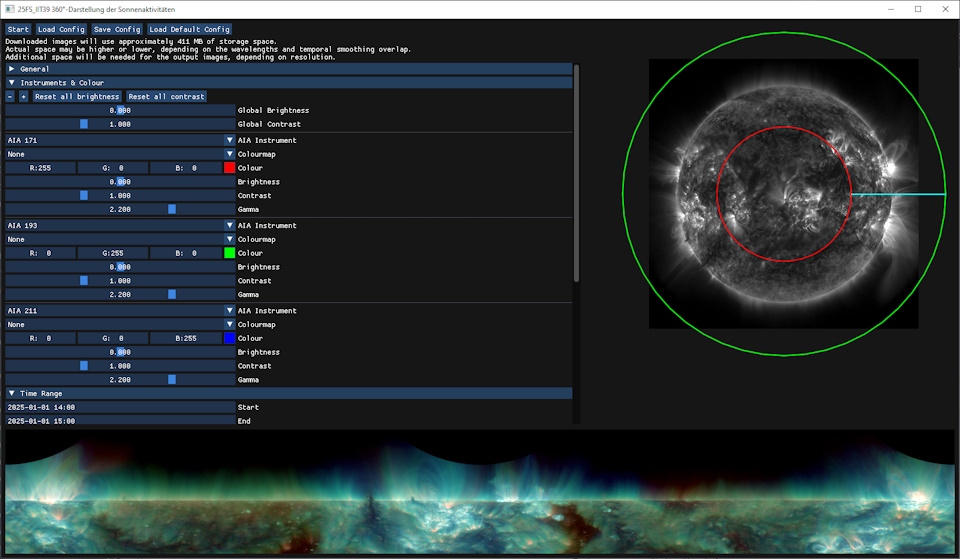
Configuration User Interface of our reference implementation. Includes a preview at the bottom of the transformation and the chosen colors and many other parameters.
Impression 2
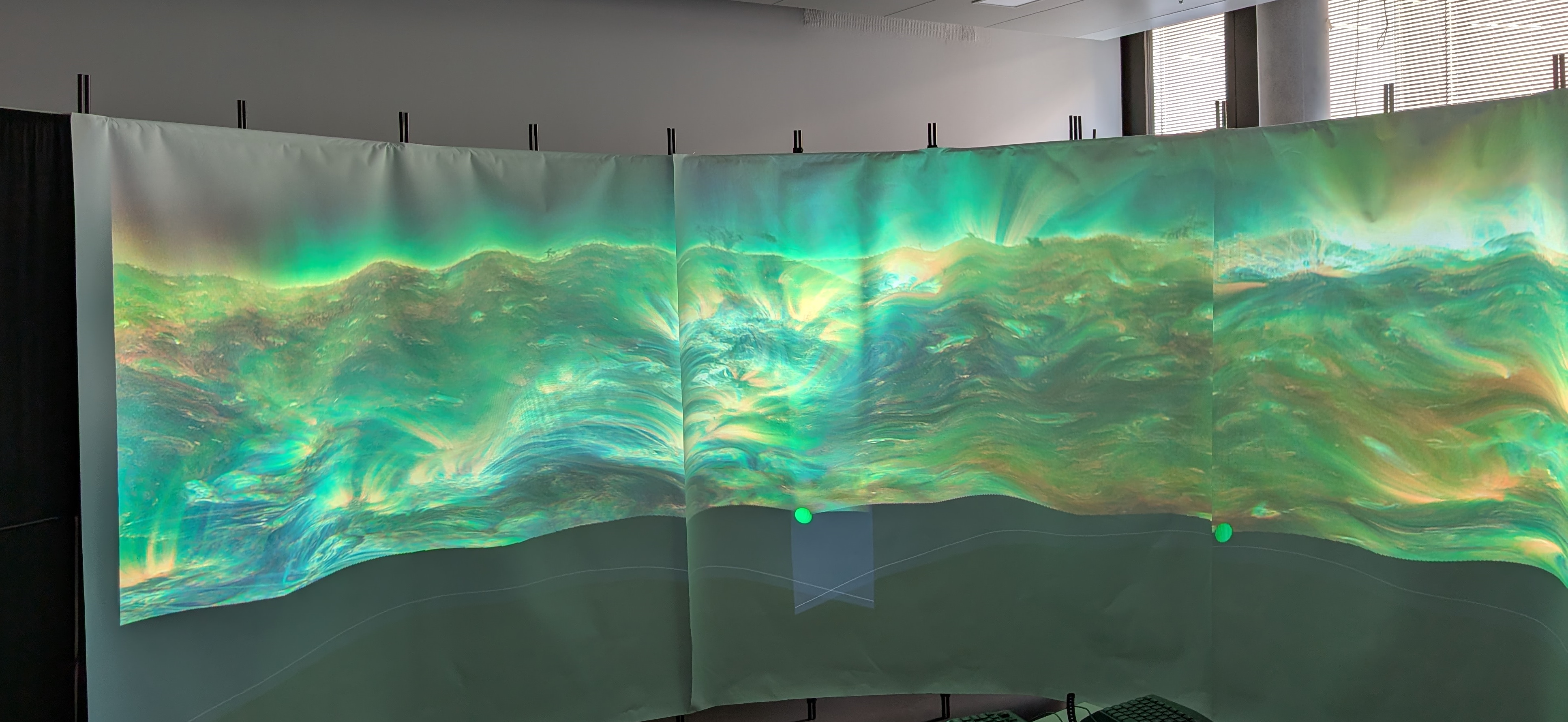
Testing the setup with a generated video, the cylindrical screen and splash, the open-source projection-mapping software.
Impression 3
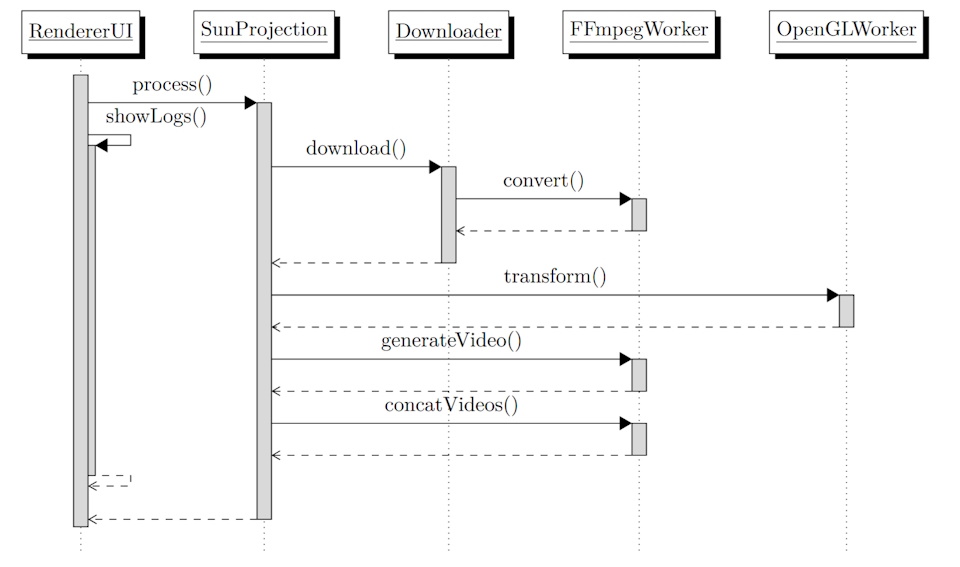
The diagram gives a high level overview of the architecture used in the reference implementation for the proposed algorithm.
Solution developed and its benefits
A pipeline with features like color-mapping, time-warping and instrument-selection that lets science communicators control a lot of parameters so they can generate captivating videos of solar activity. The imagery can be transformed such that the resulting aspect ratio is large (i.e. the videos are very wide) which is ideal for projection onto a 360° screen. The transformation immerses the viewer in a solar-surface-like point of view.
- Select up to 10 different wavelengths
- Choose colors per wavelength, or choose color maps
- Artifact and noise removal via temporal smoothing
- Fine-grained time-controls with a custom time function (reference implementation provides a curve editor)
- Append or prepend user supplied videos to e.g. visualize the journey of a satellite
- Reference implementation thoroughly tested during more than 10 video generations
The reference is is open-source, see GitLab.
The videos were projected onto a low-cost cylindrical projection screen created from room dividers and pull down screens using the open-source projection mapping software splash
Key terms
- Solar Imagery
- Sun
- Edutainment
- Computer graphics
- Image processing
- Projection-mapping
- Astrophysics
- OpenGL
Team
Samuel Burkhardt
Marius Gebhardt
Internal Customer and developer/organiser of the hardware
Hanna Sathiapal
Advisor
Prof. Dr. Hilko Cords
Simon Felix