
Strong Lens Galaxy Classification with Deep Learning
Improving the classification of strong lenses, by exploring different subsets of data and adding generated images
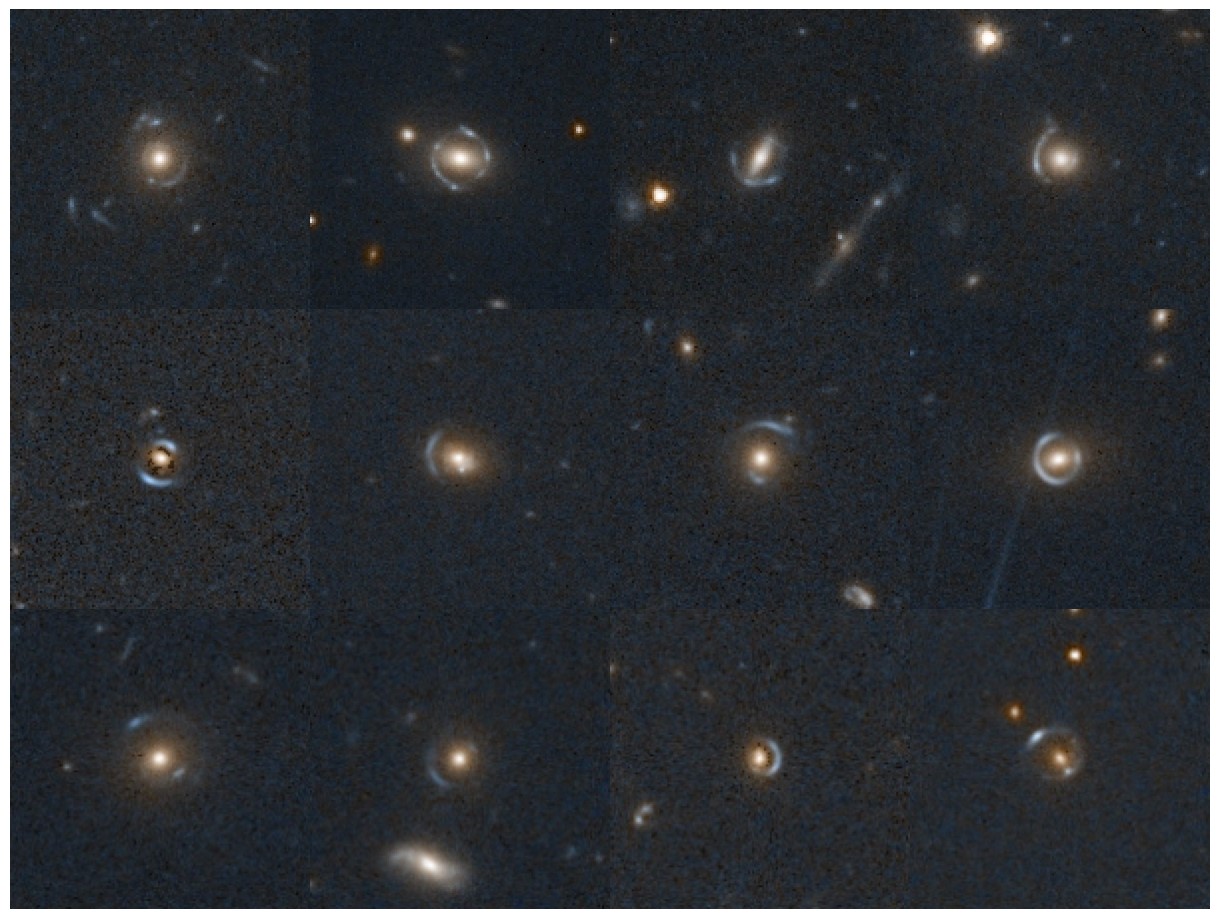
Mix of simulated strong lenses by experts and generated strong lenses by us
Initial situation
The Euclid mission will image around 1.5 billion galaxies, but only a small fraction (about 100'000) are expected to be strong gravitational lenses. Existing neural network classifiers can identify candidates, but they suffer from high false positive rates, meaning many non-lenses are incorrectly flagged and require manual review. At the same time, training data is limited: real strong lenses are rare, and simulated datasets may not capture the full diversity of galaxy morphologies, leading to reduced performance on real survey images. This situation motivated our work on developing methods to reduce the number of false positives.
Project goal
Our goal was to develop a system that detects strong gravitational lenses in Euclid survey images with high accuracy and low false positive rates. We explored how dataset diversity through different combinations of simulated lenses and real galaxies affects detection performance. In parallel, we built a conditional diffusion model to generate synthetic strong-lens and non-lens images, aiming to augment the training data with challenging examples that improve the classifier robustness. Together, these efforts target more reliable lens detection, reducing the need for time-consuming manual inspection in large astronomical surveys.
Different kind of Euclid data
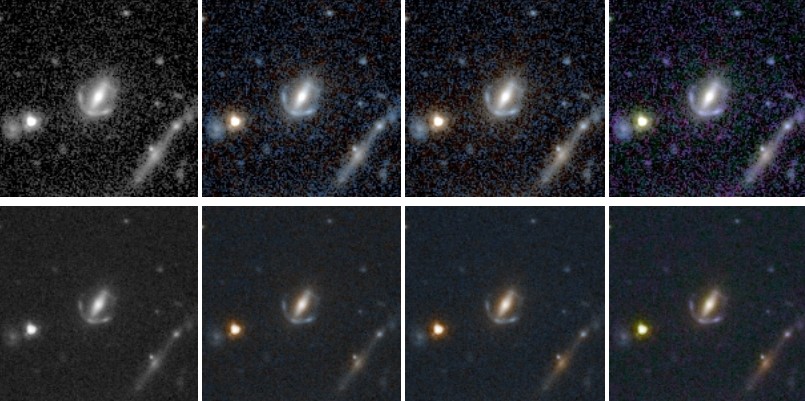
Euclid observations shown across different spectral bands (rows), with two alternative intensity mappings: arcsinh stretch (left column) and matched transfer function (MTF; right column).
Simulated strong lenses
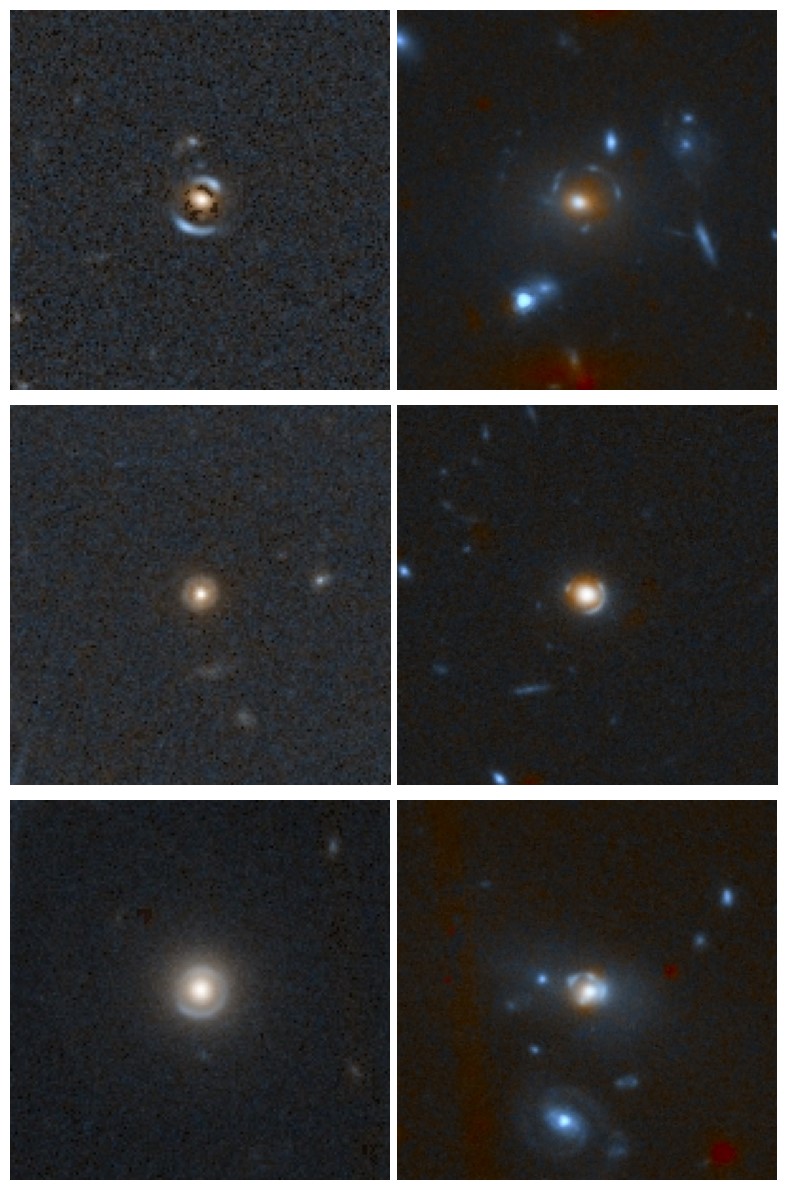
6 examples of strong lens simulations from multiple astrophysicists.
Our generated galaxies
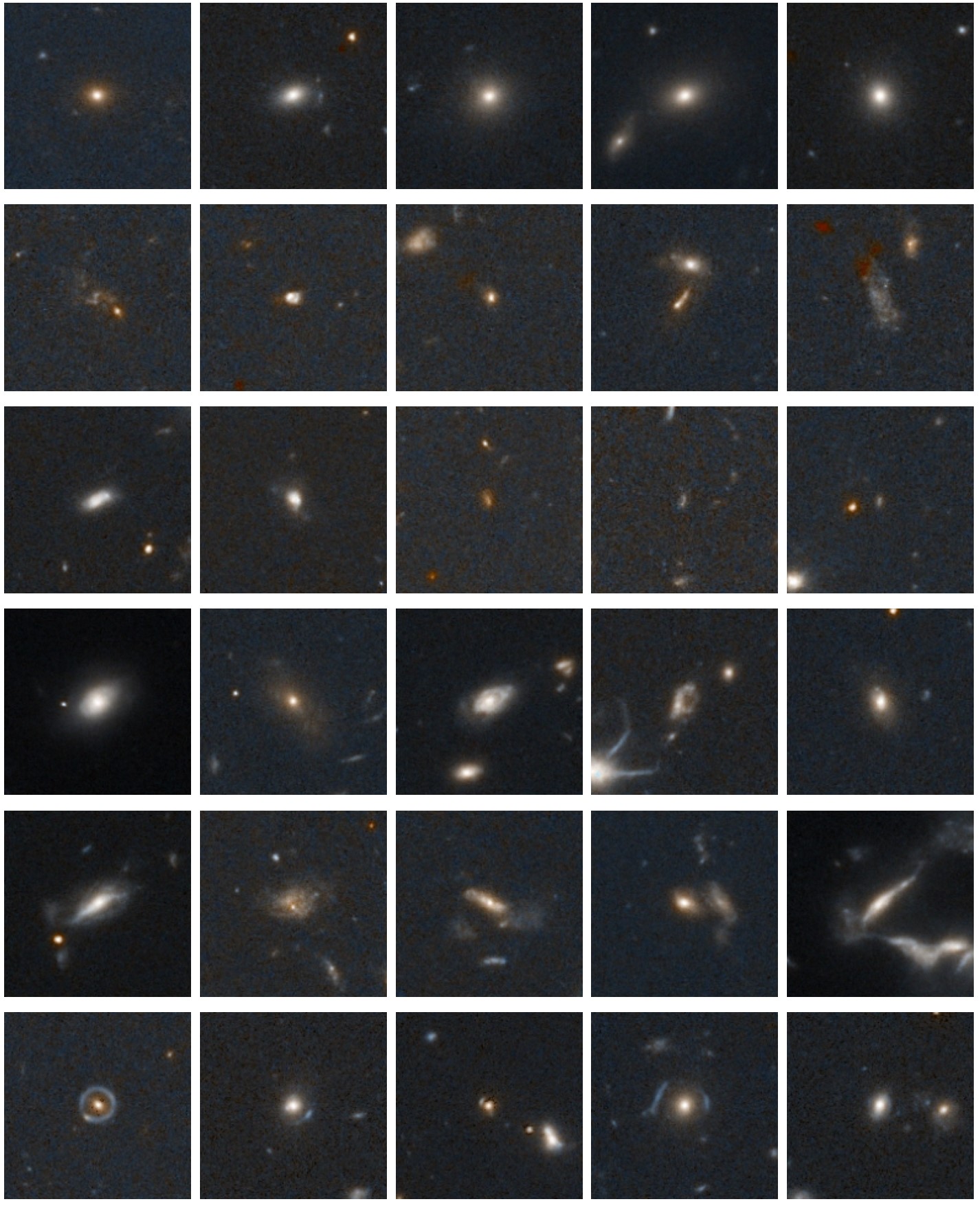
5 samples generated for each galaxy we simulated. LRGs, mergers, spiral, ring, strong lenses and other-galaxies.
Solution developed and its benefits
We developed a two-part approach to improve strong gravitational lens detection in Euclid survey data. Firstly, we systematically evaluated the impact of training data diversity by combining simulated lens images with real galaxy observations in various configurations, identifying the optimal mix that improves classifier performance. Secondly, we developed a conditional diffusion model capable of generating synthetic images of both lenses and non-lenses. These synthetic examples were tailored to include challenging, realistic variations, thereby enhancing the robustness of the classifier. The resulting system integrates these augmented datasets into a CNN-Model, delivering more accurate lens detection.
Benefits
- Reduced false positives: The improved classifier lowers the number of non-lens galaxies incorrectly flagged, reducing the manual review workload for astronomers.
- Enhanced training diversity: By incorporating both real and realistically simulated data, including synthetic images from the diffusion model, the system is better equipped to generalize to the diverse morphologies present in real survey data.
- Improved detection accuracy: The enriched dataset and optimized training strategies result in a more precise identification of strong gravitational lenses.
Key terms
- Deep Learning Machine learning techniques using neural networks for complex pattern recognition
- CNN Convolutional neural network, a class of deep learning models for image processing
- Strong gravitational lens A galaxy that bends light from a more distant object, creating arcs or rings
- False positive rate (FPR) Proportion of non-lenses wrongly identified as lenses
- Diffusion model A generative deep learning technique for creating realistic synthetic images
Institute for Data Science (i4DS)
FHNW University of Applied Sciences and Arts Northwestern
Bahnhofstrasse 6
5210 Windisch
Institute for Data Science
Team
Juan Ruiz
Kevin Wartmann