We tried improving a BERTweet classifier's performance on an imbalanced dataset using Large Language Models (LLMs) for weak labeling and data augmentation. The results showed our approach wasn't optimal. The unpredictable behavior of LLMs poses challenges. However, LLMs hold vast potential. To tap into this potential, we advise refining test methodologies, balancing data, and exploring larger models.
Natural Language Processing, Text Classification, Few-Shot Learning, Large Language Models, Weak Labeling, Data Augmentation
In the current digital age, the rapid spread of false information, especially on platforms like Twitter, holds the power to greatly impact societies. In Switzerland, Twitter is an important space for political and scientific circles. Twitter data was analyzed in a previous project by the I4DS. The work involved identifying state-linked information campaigns and building a machine-learning model for tweet classification. The tweets were labeled in an annotation process where three raters annotated 5'000 tweets.
This project seeks to refine and advance the tweet classification methodologies previously presented in a report by the I4DS. The core challenge addressed is the inadequate performance of the multi-label classification model on underrepresented classes. Four primary tasks guide the project's trajectory:
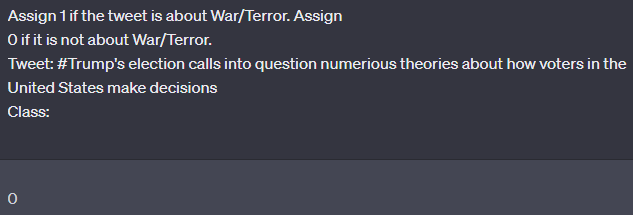
We tested several LLMs using handcrafted prompts and weakly labeled 2'000 tweets with them. Due to the "binary" nature of the prompts (see image below depicting an example prompt with an LLM) and time constraints, we weakly labeled the 6 lowest performing classes. Some of the weakly labeled classes improved in performance while the other classes declined in performance due to the added noise. We also highlight that our approach is not optimal and can be easily improved. Our tests with LLMs show the sensitivity of models to small word changes in prompts. LLMs are prone to not understanding complex instructions and tend to "hallucinate" pointless information. Future research might consider exploring varied LLM parameters, harnessing their inherent ability to generate detailed explanations, or a different data sampling strategy.
Projektdauer: 20.02.2023 - 18.08.2023
Aufwand: 360h
Teamgrösse: 1
armasuisse S+T
Cyber Defence Campus
Feuerwerkerstrasse 39, 3602 Thun
Bruno Baptista Kreiner, BSc Data Science
Daniel Perrouchoud, daniel.perruchoud@fhnw.ch
Fernando Benites, fernando.benites@fhnw.ch
