In this project, a mobile cyber security learning solution was developed.
Flutter, Dart, HTML, JavaScript, Node.js, Express, MongoDB, Android, iOS, Cyber Security, Mobile, Learning, Communication
The goal of this project is to validate and provide a proof of concept for a mobile cyber security learning application, to assist the owners and employees of small and medium-sized enterprises (SMEs) in learning about cyber security concepts and provide instructions for cyber security related tasks. The key aspect of this solution is to combine a structured, linear learning experience in the form of compact lessons with a communicative aspect which allows a learner to ask questions and receive support from cyber security experts or other, more experienced learners and to engage in discussion and collaborative learning with them. To allow learners to freely ask questions without fear of negative judgment, the option to remain anonymous when participating in such a communication channel is vital. Ways to encourage learners to return to the app and continue learning are evaluated.
Cyber attacks are serious threat to SMEs in Switzerland. In modern times, even SMEs which are not concerned with offering IT services or development use many IT devices in their daily business, which can range from PCs and Laptops, to smartphones and many others. Because of this, the majority of SMEs (62%) experience a cyber attack within a year, and 60% of SMEs hit by a serious cyber attack are subsequently forced to go out of business. Cyber security workshops exist to counteract this issue, however these can be financially costly and also time-consuming and are thus often not an option for SMEs. GEIGER is a Horizon 2020 project which seeks to aid such SMEs by providing a suite of tools to enable them to assess and improve their cyber security and protect themselves from cyber threats. GEIGER Mobile Learning then provides an educational component to this suite.
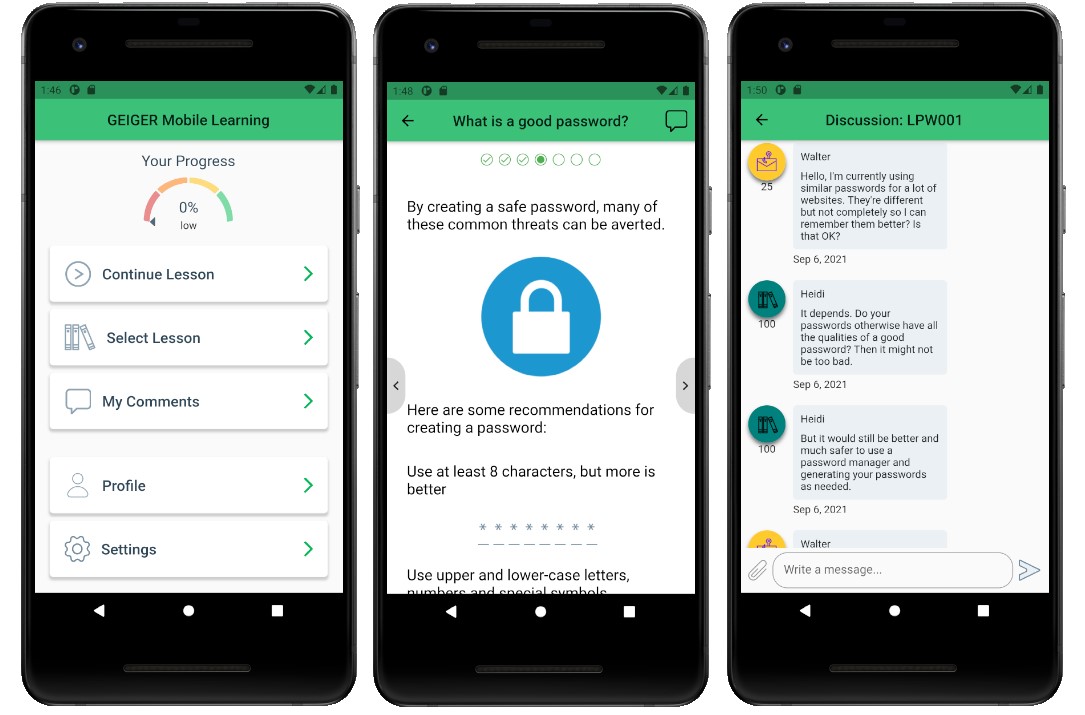
A Flutter application targeting Android and iOS was developed. In this application, it is possible to undertake compact, structured lessons about various cyber security concepts. These lessons are provided as HTML pages which are viewed via an internal web view. This allows the easy creation of new lessons with direct visual feedback for how the result will appear, as well as offering a wide range of possible media types to be used in lessons, such as images, links to websites, documents, videos, etc. During a lesson, should questions about the content or a problem in the real workplace arise, the learner can directly enter a communication channel, where they can ask a question or explain the problem which they have encountered. Cyber security experts or other learners can then provide support. In this communication channel, text and images can be used to describe a problem or provide visual guidance as well. Users also have the ability to remain anonymous when using the communication channels. The application was tested with SME owners, employees as well as other potential users to validate the concept. Users appreciated that the compact, structured lessons allow them to conveniently learn about cyber security concepts in short bursts and at their own pace, for instance during commutes. Awarding score after the completion of a lesson gives the learner feedback which encourages them to continue learning. The communicative aspect of the application was also appreciated, because its design is similar to instant messaging apps such as WhatsApp and Telegram, which the users are familiar with. Moreover it was appreciated that a question that was answered by someone benefits every learner who may have the same questions or encounter the same problem.
Project Duration: March - September, 2021 Time Investment: 720 hours (360 hours per student) Team Size: 2
Prof. Dr. Samuel A. Fricker Deputy Head of Institute Bahnhofstrasse 5 CH-5210 Windisch, Switzerland FHNW University of Applied Sciences and Arts Northwestern Switzerland School of Engineering Institute for Interactive Technologies IIT
Turan Ledermann (turan.ledermann@students.fhnw.ch) Felix Mayer (felix.mayer@students.fhnw.ch)
Prof. Dr. Samuel A. Fricker (samuel.fricker@fhnw.ch) Louis Baumgartner (louis.baumgartner@fhnw.ch)