
Automated Creation, Validation, and Evolution of Personas
Personas are widely used in software development to represent typical user groups, but they are often costly to create, rarely validated, and commonly remain static artifacts that become outdated. This project demonstrates a data-driven approach that combines behavioral monitoring data and explicit feedback to support the continuous creation, inspection, and evolution of persona-like artifacts through an interactive dashboard.
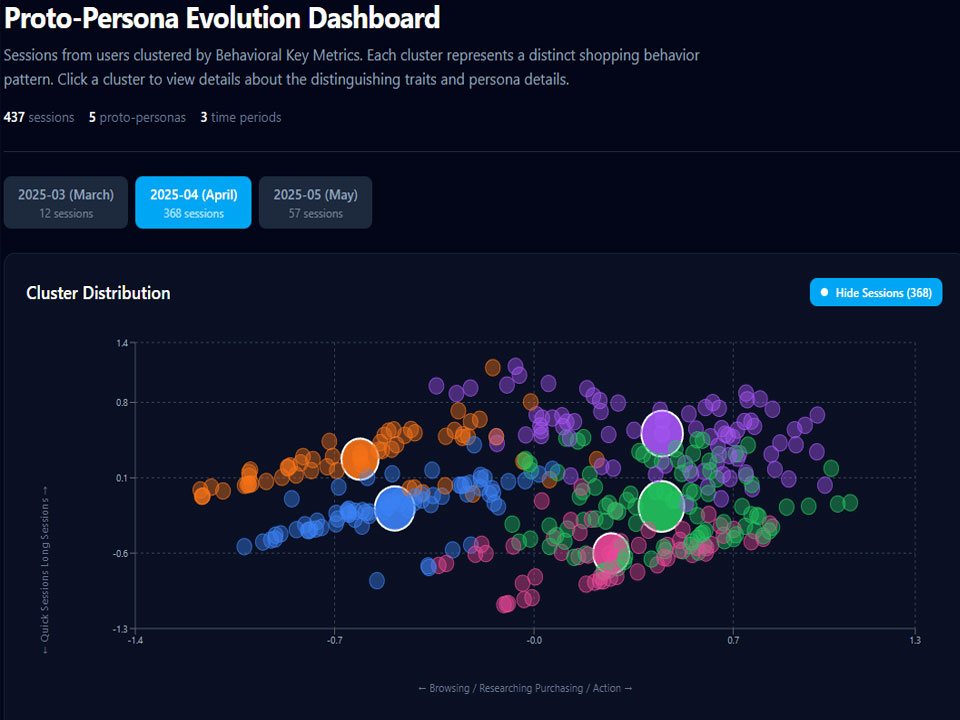
Dashboard
Prototype Interface
Initial situation
In software development, personas are traditionally created at the beginning of a project using qualitative methods like interviews. While these provide deep insights, they are often time-consuming, expensive, and subjective. A critical issue is that they usually become "static artifacts" or "flat files" (e.g., PDFs). Once created, they are rarely updated, meaning they fail to reflect the dynamic reality of changing user behaviors and market conditions throughout the product lifecycle.
Problem statement / Project goal
Despite the availability of large amounts of usage data, there is no established mechanism to make the validity and evolution of personas transparent and operationalizable. The goal of this project was to develop a technical artifact that transforms personas from static snapshots into "living models." The system aims to identify user groups from behavioral data, generate interpretable "Proto-Personas" using LLMs, and visualize the "persona drift" and evolution across different time windows.
Cluster Overview
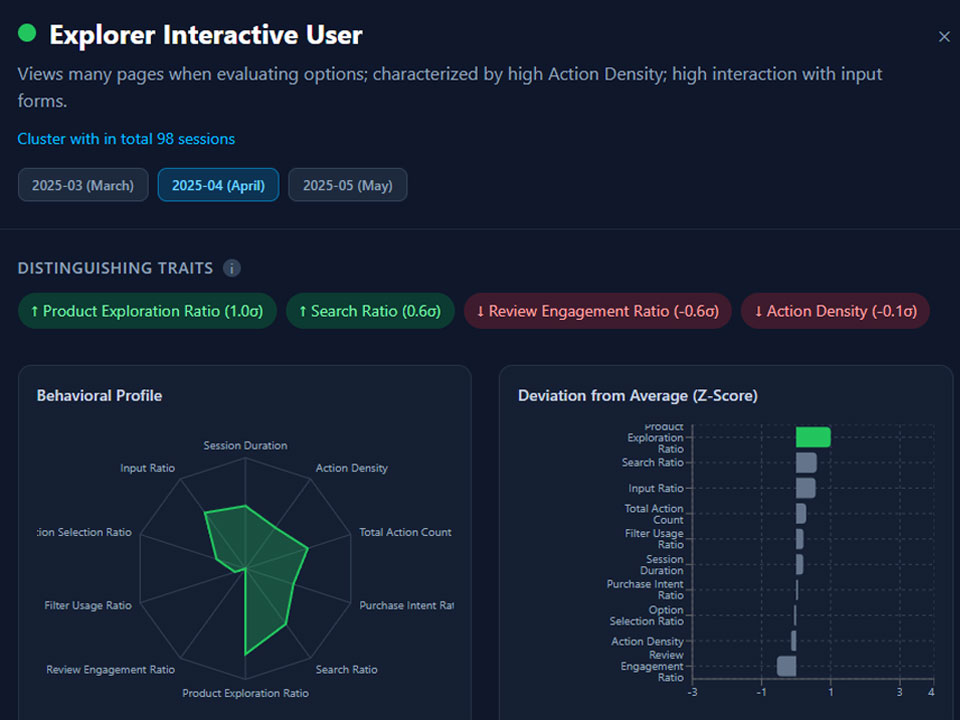
High-level cluster overview showing user segments.
Proto-Persona Detail View
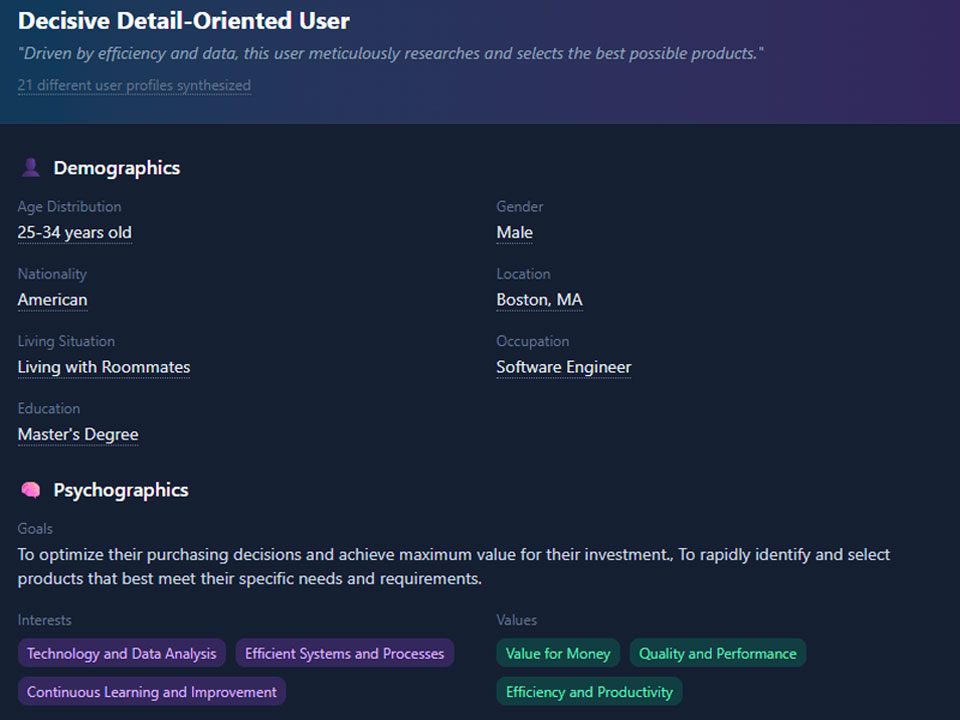
Detailed view of a generated proto-persona.
Monthly Comparison
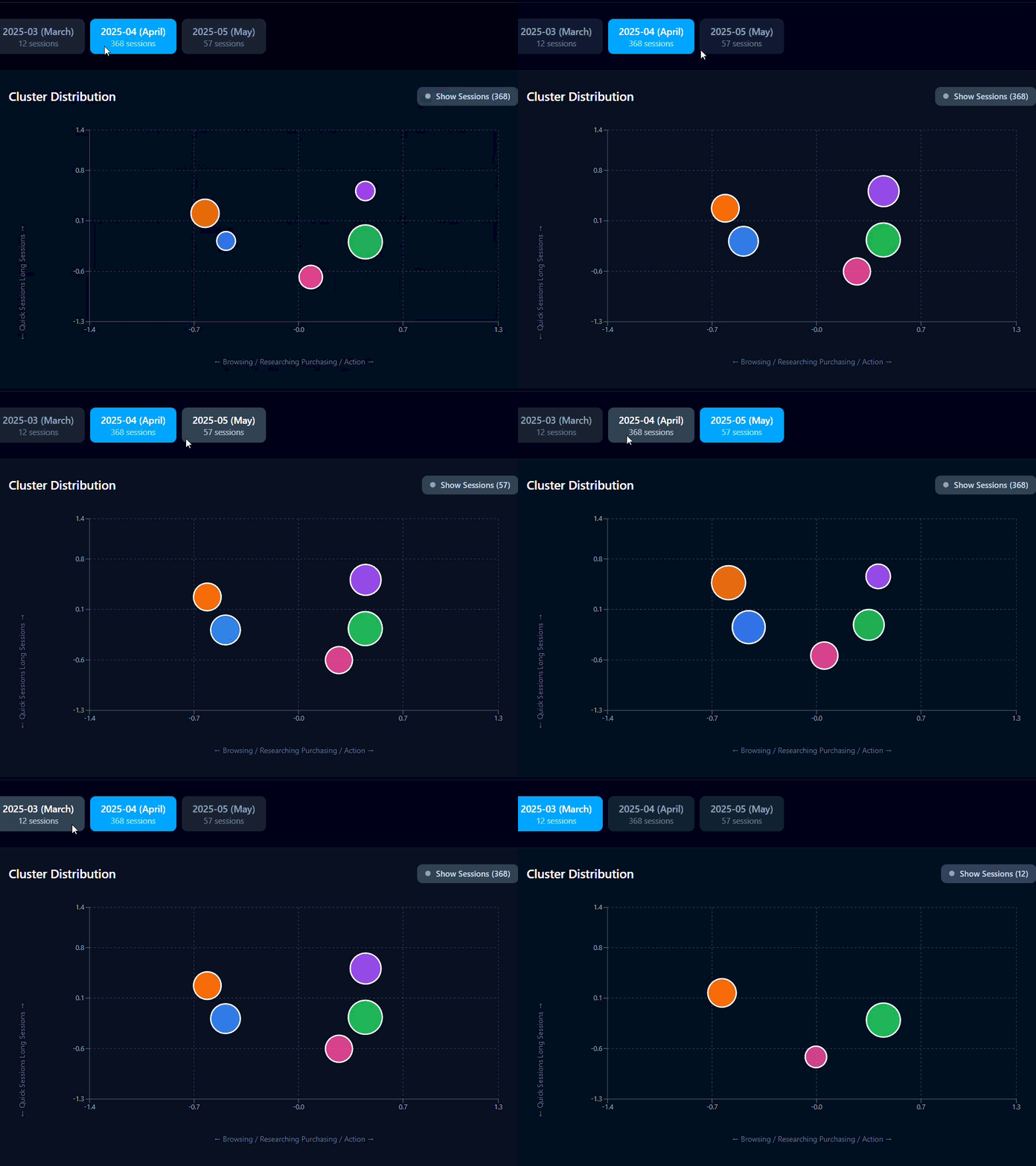
Tracking persona drift across different time windows.
Solution developed and its benefits
The team developed an end-to-end processing pipeline and an interactive web dashboard. The system processes e-commerce session data to group users into behavior-based clusters (e.g., "Search-Driven" or "Decisive"). It then utilizes Large Language Models (LLMs) to synthesize narrative proto-personas for each cluster, enriching quantitative metrics with qualitative context from user transcripts. The React-based dashboard allows stakeholders to explore these profiles interactively.
Key features:
- Behavioral Clustering: Automatically segments users based on key metrics like session duration and purchase intent.
- LLM-supported extraction of structured user profiles from interview transcripts, with schema validation.
- Temporal Evolution: Visualizes changes in user groups over months, allowing detection of trends and behavioral drifts.
- Evidence & Transparency: Provides "confidence" indicators and data coverage metrics.
- Interactive Exploration: Supports a "drill-down" approach from a high-level cluster overview to individual session details.
Key terms
- MethodologyData-Driven Persona Development (DDPD)
- AnalysisBehavioral Clustering, K-Means, User Analytics
- ConceptProto-Persona, Personas, User Experience (UX)
- TechnologyLarge Language Models (LLM), Schema Validation
- VisualizationInteractive Dashboard, Persona Evolution, Temporal Comparability
- QualityInterpretability, Transparency, Evidence/Coverage
Customer
FHNW
University of Applied Sciences and Arts Northwestern Switzerland
Bahnhofstrasse 6
5210 Windisch
www.fhnw.ch
Team
Miro De Nardo
Andrin Sibold
Supervisors
Prof. Dr. Norbert Seyff
Dr. Nitish Patkar