
Design and Implementation a Web3 Platform Connecting Farmers & Certifiers
A platform that reduces certification admin work by letting farmers record production data, share it with certifiers, and store approved certificates as verifiable on-chain records.
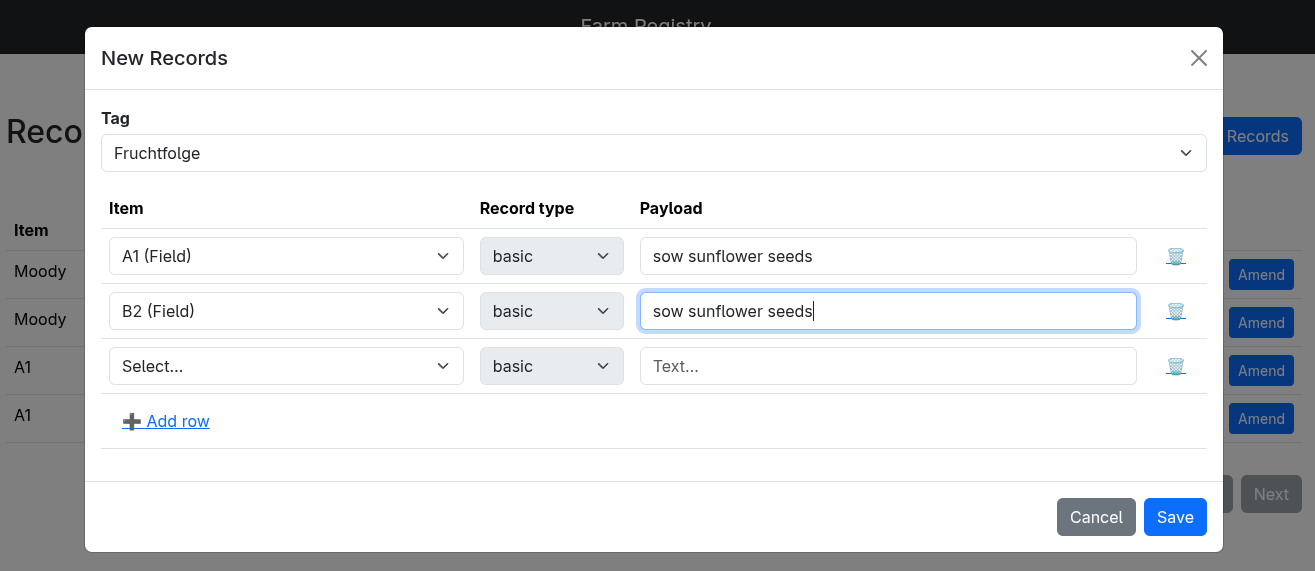
Screenshot: bulk record entry
Initial situation
Farmers increasingly need external certifications (e.g., organic or sustainability labels) to meet market expectations. In practice, certification workflows are not uniform: documentation tools are often tied to specific schemes or certification bodies, and farmers end up duplicating effort when they work with multiple certifiers.
Inspections are typically control-oriented: inspectors request specific sets of records (sometimes on short notice), and farmers must provide the relevant information quickly. At the same time, farmers are concerned about being monitored too closely and want to stay in control of who can access which data.
Problem statement / Project goal
The goal was to design and implement a prototype that:
- offers a simple workflow for recording farm-related data (assets and records), including bulk entry;
- supports tagging and grouping to quickly retrieve inspection-relevant subsets;
- enables controlled, role-based access so certifiers can issue certificates;
- stores approved certifications in a tamper-resistant and verifiable way, while keeping the platform extensible.
Impression 1
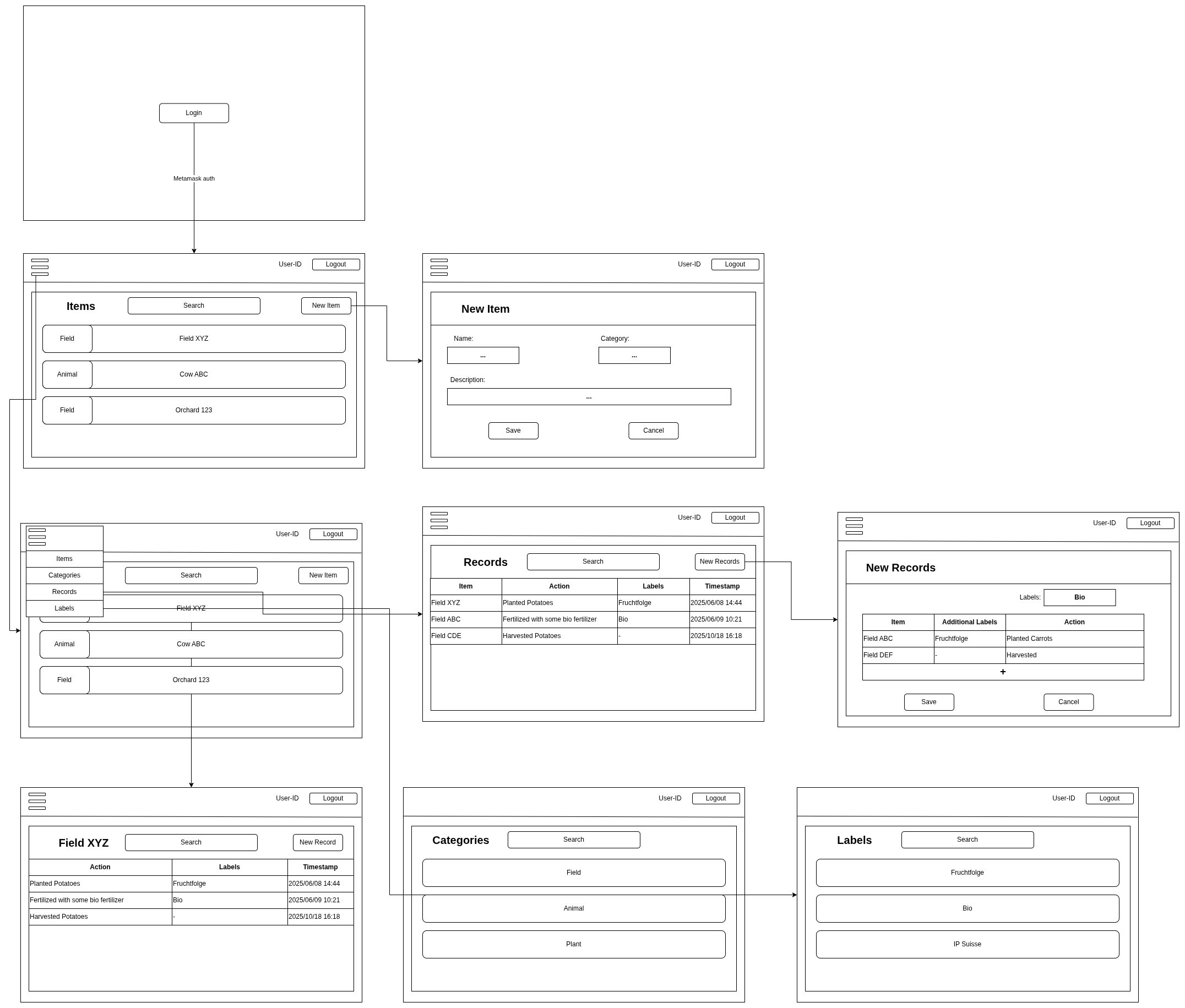
Early wireframes used a straightforward flow: manage items (e.g., fields/animals), enter records, and prepare data for inspections.
Impression 2
Bulk data entry supports how farmers work in reality: notes are collected first and entered later in batches.
Impression 3
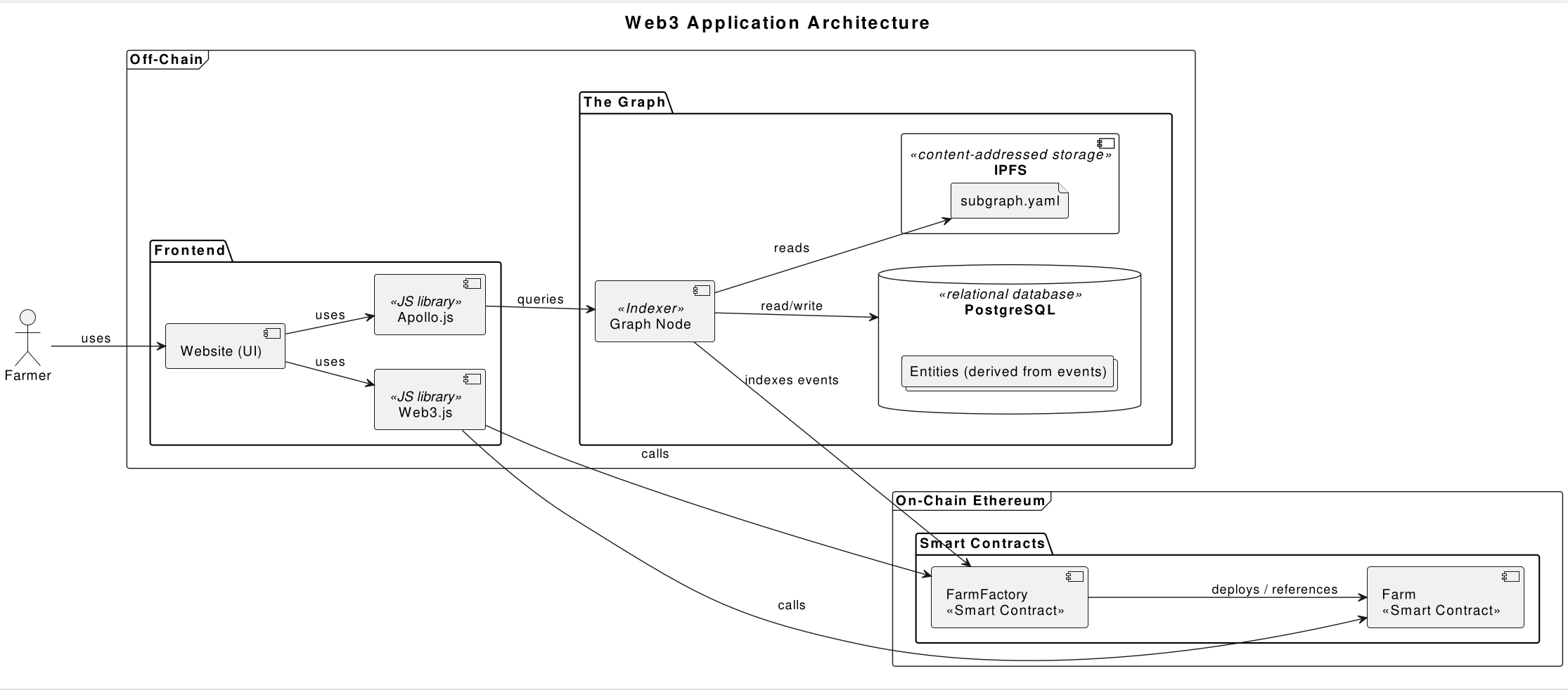
Architecture: smart contracts for integrity + an indexing layer (The Graph) for scalable querying in the web UI.
Solution developed and its benefits
The prototype combines a web frontend with Ethereum-compatible smart contracts. Farmers create and manage their farm assets (items) and add records to them. Certifiers can be granted a dedicated role that allows issuing certificates for selected items. Key interactions emit blockchain events, which are indexed by a subgraph so the frontend can query data efficiently.
The system was deployed in a public test environment:
smart contracts on the Celo
Sepolia test network, a subgraph on The
Graph Studio,
and the web frontend hosted on Cloudflare
Pages.
Check out the deployed contract here!
- One platform, multiple schemes: reduce duplicate documentation across certifications.
- Farmer-controlled sharing: role-based permissions and access.
- Verifiable audit trail: approved certificates and interactions are tamper-resistant on-chain.
- Fast inspection preparation: tagging/grouping and bulk entry support preparation workflows.
- Scalable data: off-chain indexing enables responsive search and filtering in the UI.
- Expandable design: new record types and certification requirements can be added over time.
Key terms
- TraceabilityKeeping production steps and provenance linked across processing stages.
- BlockchainPublic ledger used for verifiable, tamper-resistant records.
- Web3New World Wide Web iteration incorporating concepts such as decentralization, blockchain and tokenomics.
- Smart contractsOn-chain programs used for role-based permissions data recording and certificate issuing.
- The Graph (Subgraph)Indexing layer that turns contract events into queryable entities.
Customer
FieldFlow SARL-S
Egor Ermolaev
Howard MacLennan
https://fieldflow.lu/
Team
Robin Hartmann
Romain Nykyforchyn
Advisors
Prof. Dr. Anton Fedosov
Manuel Riedi