
Real-time Solar Flare Localization using STIX data and Machine Learning
Solar flares are powerful explosions on the surface of the Sun that emit intense X-ray radiation. This project investigates how machine learning can be used for real-time estimation of solar flares’ position on the Sun from X-ray data by the Spectrometer/Telescope for Imaging X-rays (STIX).
Initial situation
The STIX telescope on board ESA’s Solar Orbiter mission observes the X-ray emission from solar flares. The instrument does not capture images directly. Instead, flare images are reconstructed on the ground from detector measurements using computationally intensive algorithms. A Deep Learning (DL) approach has been implemented to reconstruct STIX images in real time, but the input data must first be calibrated. This calibration step requires a reliable estimate of the flare location.
Project goal
The goal is to estimate the (x, y) coordinates of the flare position on the solar disk directly from raw STIX detector counts. This position estimate is used to calibrate the detector data before it is passed to the image reconstruction model. The localization accuracy must be better than 30 arcseconds for precise data calibration.
Approach
We train a Multi-Layer Perceptron to predict the coordinates of the solar flare location from raw data provided by a subset of STIX detectors. The STIX observations are labelled with the corresponding flare locations estimated from reconstructed images. However, since labelled STIX data are limited, we also generate simulated samples and train on a mix of real and synthetic data.
Solar Flare Distributions
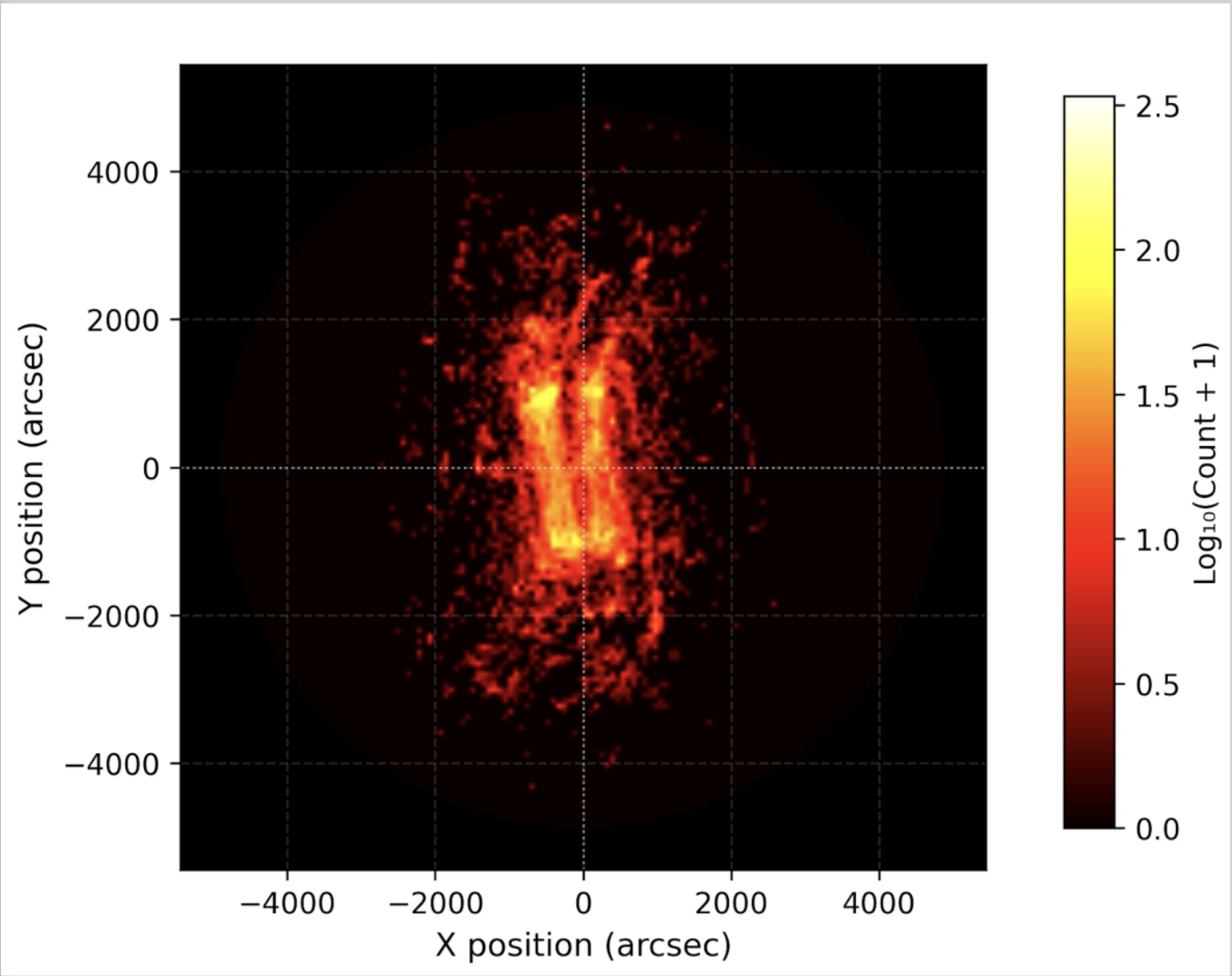
Spatial distribution of reconstructed flare positions in the STIX reference system.
Training Strategies
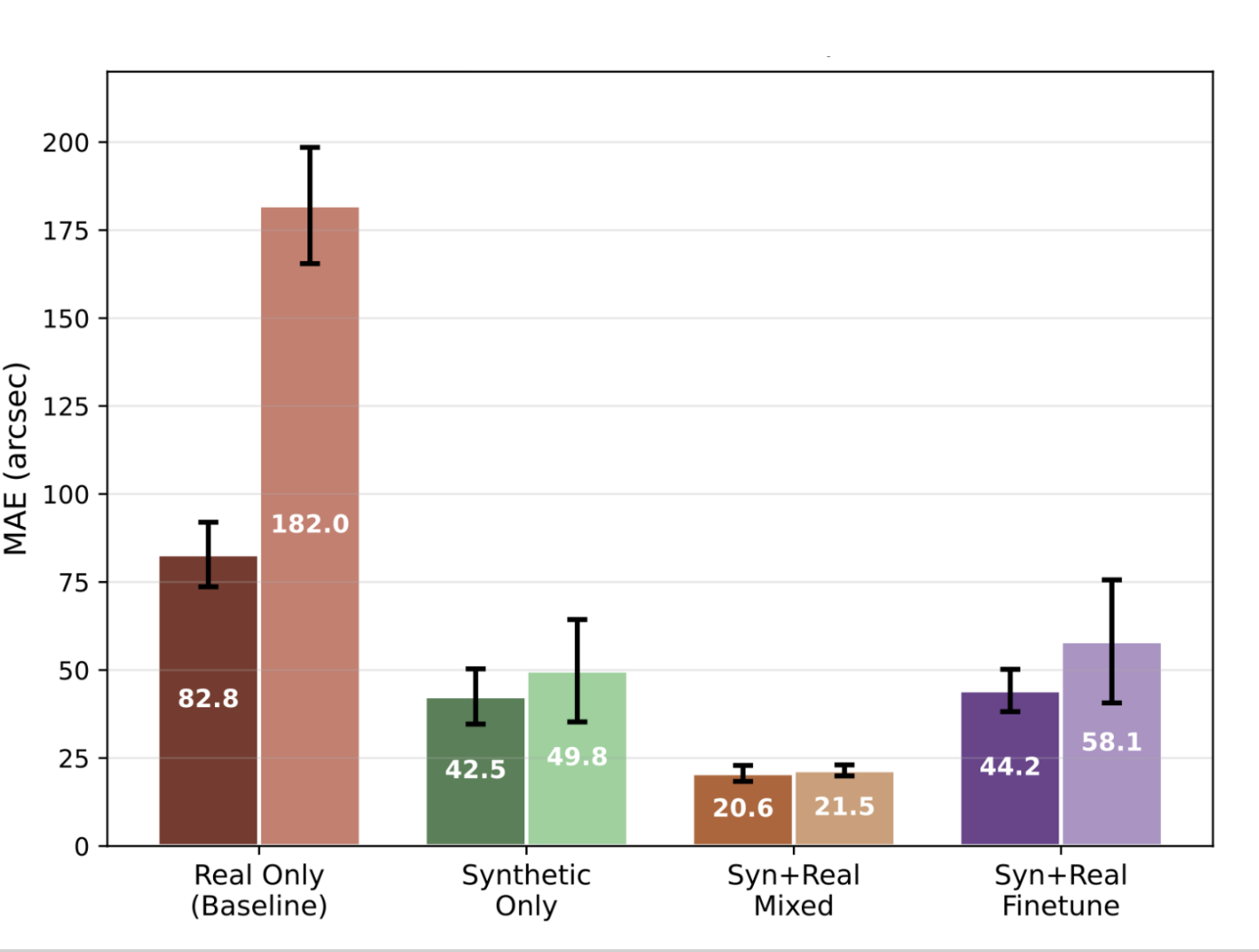
Comparison across four training strategies (5 runs, mean ±1σ) and reporting the Mean Absolute Error (MAE) for X (left bar) and Y (right bar).
Spatial Error Map
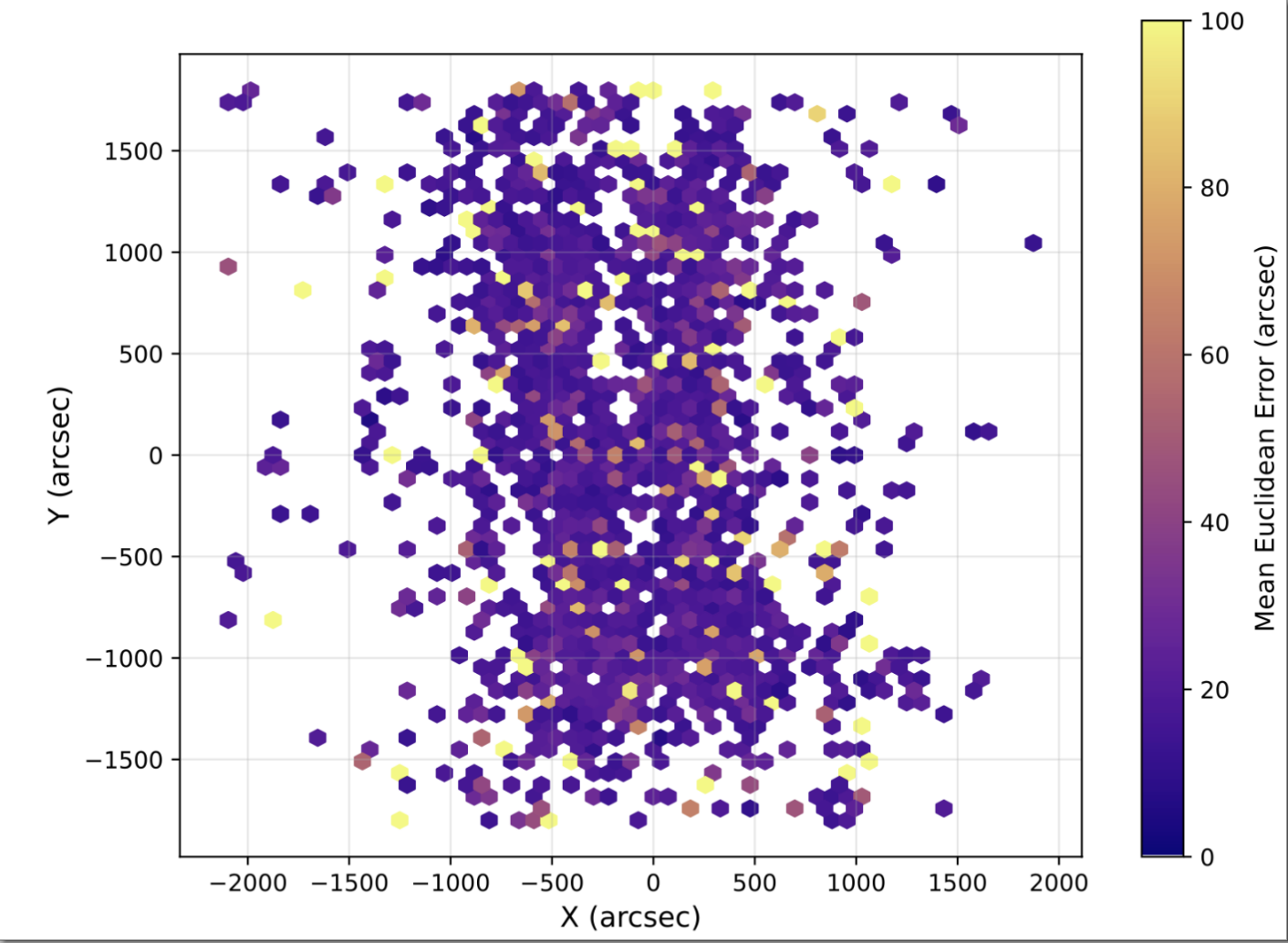
Spatial error map for the mixed model. Flare positions are binned in the X, Y plane and each cell is colored by the Mean Euclidean Error of samples falling into that bin.
Solar Orbiter

Solar Orbiter is a Sun-observing satellite with 10 science instruments, all designed to provide unprecedented insight into how our local star works.
Solution developed and its benefits
Training an MLP exclusively on real data did not yield sufficiently accurate predictions, as the available dataset of approximately 20 thousand events was too limited. To address this limitation, we investigated two strategies:
- Pretraining on simulated data followed by fine-tuning on real data
- Training on a mixed dataset containing both simulated and real data
The second approach produced superior results when evaluated on a test set of real observations. Using this strategy, we achieved a mean absolute error of approximately 21 arcseconds for both X and Y, meeting the target requirements.
Next Steps
Next, we plan to integrate the localization model into the STIX Data Center. In particular, we would like to embed our model within an interactive interface allowing the user to select the STIX detector counts in time and energy to obtain the corresponding image in real time. Our model will be used for the data calibration step based on the flare location estimate, which is necessary to apply the DL image reconstruction method. Further, future work will focus on the application of explainable AI methods for a deeper understanding of the performances of our model.
Key terms
- Machine LearningComputational methods that learn patterns from data to make predictions
- STIXX-ray telescope on ESA’s Solar Orbiter spacecraft.
- Multi-Layer Perceptron Fully connected neural network used for position prediction.
- Arcsecond Angular unit used to measure positions on the solar disk.
From Earth, 1 arcsecond corresponds to ~700 km on the Sun
Team
Maik Degen, Erhan Bilgili
Advisors
Paolo Massa
Säm Krucker